

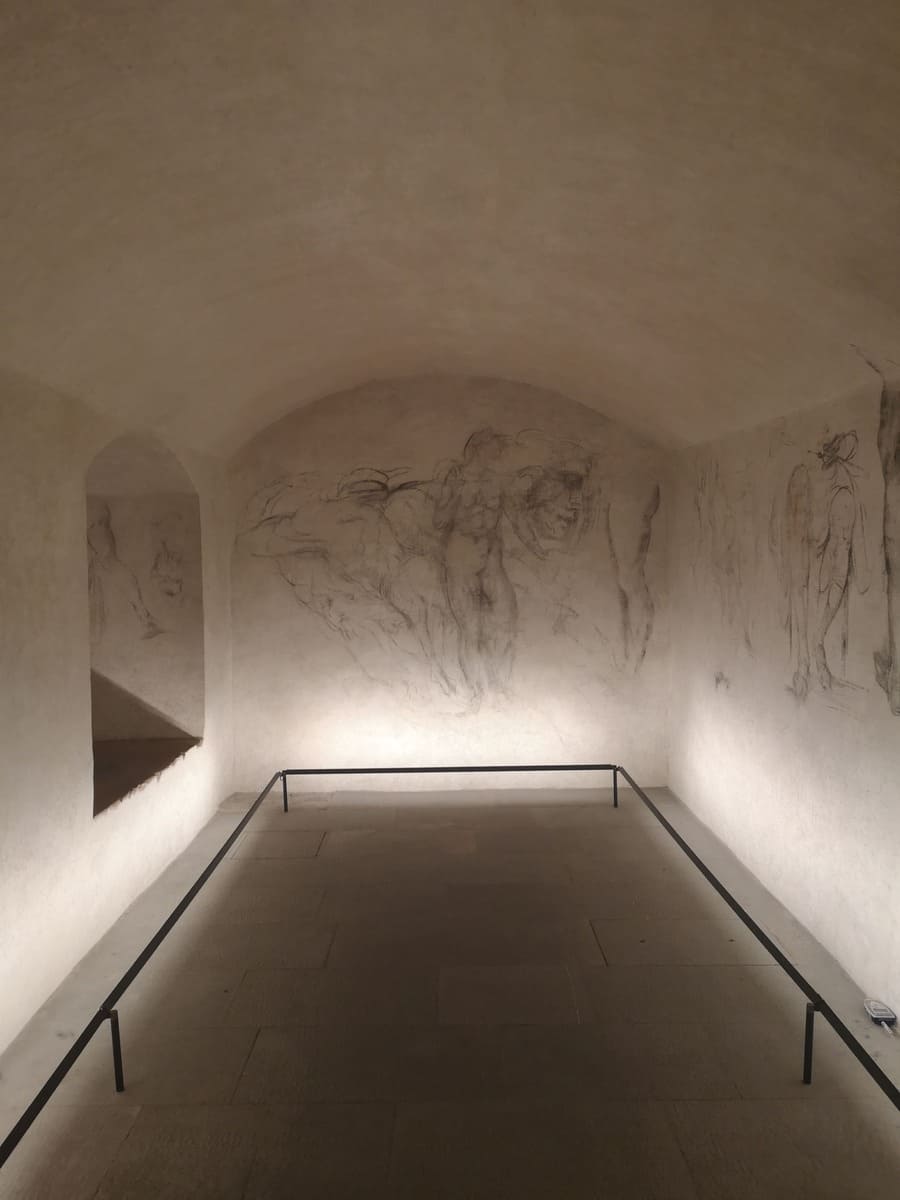
In November 2023, the Medici Chapels reopened the so-called Michelangelo’s Secret Room. Newspapers around the globe announced this important event, inviting the visitors to this intriguing space, where the artist was supposed to hide in 1530, during the siege of Florence.
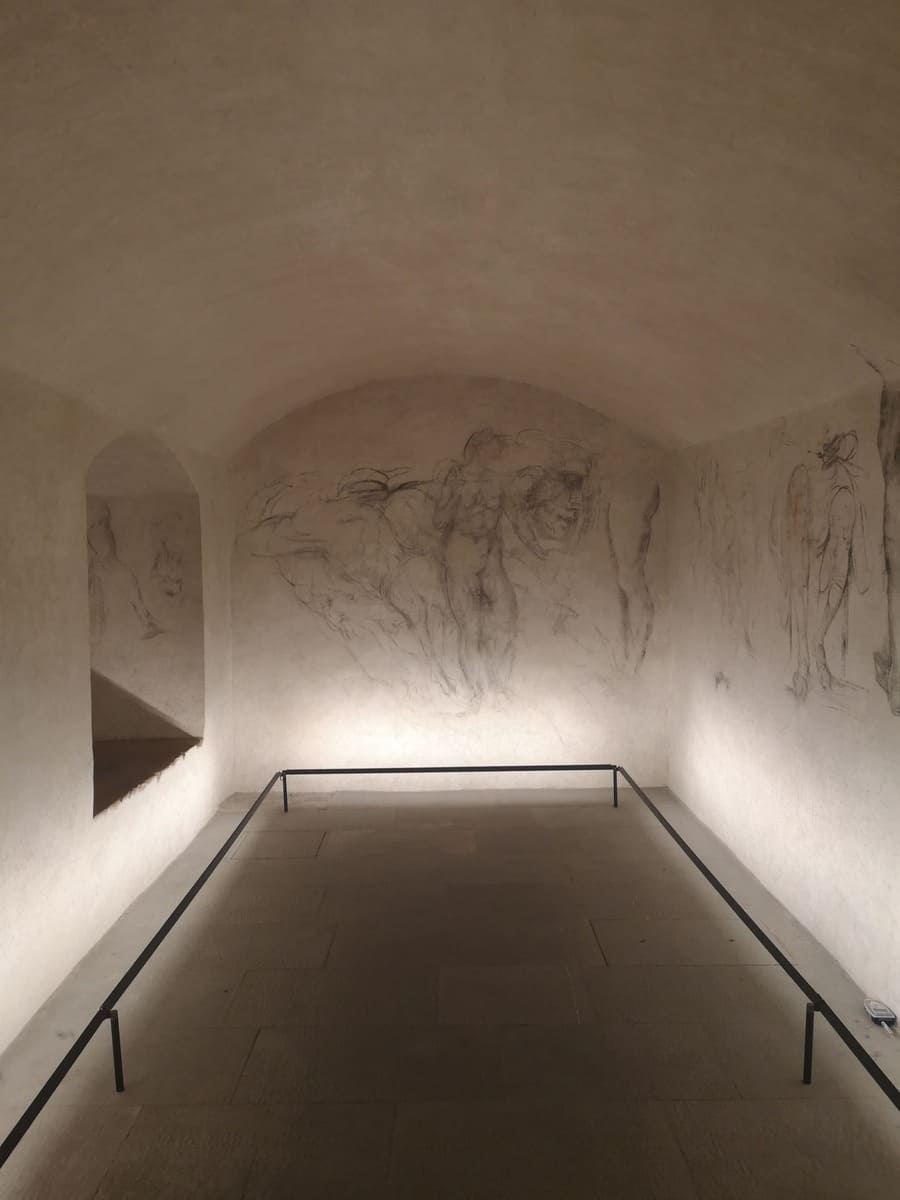
This long and narrow room, located in the New Sacristy at the Florentine Basilica of San Lorenzo, truly is one of the most fascinating documents linked to the great Renaissance artist. Yet, it’s not because of the story of the siege. Do you want to know what this room really is and why it’s relevant for Renaissance art history?
Let me take you on a tour through Michelangelo’s “secret” room.
Michelangelo’s secret room: background and discovery
It was November 1975. Given the growing number of visitors, the Medici Chapels museum was trying to create a new entrance to the complex, and so they were looking for possible solutions. One of the guardians, who daily sat in Michelangelo’s New Sacristy, remembered that under a heavy wardrobe in one of the side rooms of the Sacristy, there was a hidden space, where they used to store charcoal for the heaters. The wardrobe was moved, and Paolo dal Poggetto, the museum director, went down a steep staircase to see a long, narrow room with a well and a small window. Before any construction works could start, a deeper investigation carried out by an art conservator was necessary.
It was only then, when the two layers of plaster were taken down from the walls, that the conservator Sabino Giovannoni, revealed the charcoal drawings in the room.
For the heritage professionals in Florence, the importance of this discovery was immediately clear. However, Paolo dal Poggetto had to convince state authorities to attract funding for the necessary restorations. This is possibly the reason why he linked the room with Michelangelo’s troubled relationship with the Medici family and told the story of the artist hiding there during the siege of Florence. Despite the lack of any documentary support for this narrative, the room became known as “Michelangelo’s secret room”. Closed to the public for decades, now we can again visit this unique space and learn more about Michelangelo’s work inside the New Sacristy.
Michelangelo’s secret room: what is it?
If the story of Michelangelo hiding inside this room is a captivating but not really probable narrative, what is this room really?
I always say that the historical truth is more interesting than our made-up stories. In fact, this very room is the only surviving Renaissance artistic workshop preserved as a physical space that has been preserved almost untouched. The workshop spaces had to be truly fascinating environments where the artists expressed their raw creativity. They were spaces of coworking, cooperation, and exchange of ideas. Our knowledge about the Renaissance workshops arrives mainly through very few drawing books survived, like the precious Codex Escurialensis preserved at the Library of the Royal Monastery of San Lorenzo de El Escorial.
Surprisingly, we know the precise locations of the workshops of the main Renaissance artists, like Donatello or Ghiberti, but today these spaces serve completely different purposes. Donatello’s workshop, for example, serves today as a touristy restaurant, called, not by chance, Le Botteghe di Donatello (Donatello’s workshop).
This is why the existence of Michelangelo’s workshop space that the artist and his pupils used during their work at the New Sacristy in San Lorenzo is so unique.
Michelangelo’s secret room: what to see?
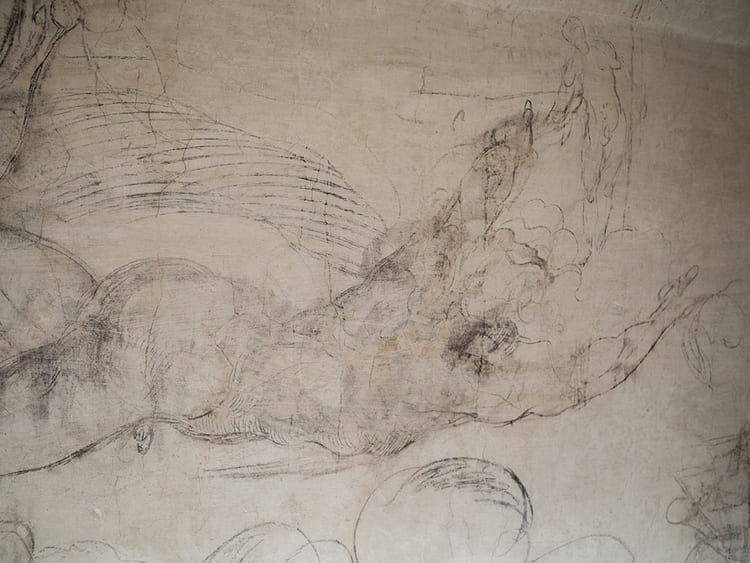
The narrow room hidden under the floor of the sacristy was used by Michelangelo as a sort of sketchbook. We have to remember that paper was not that easily accessible back during the early 16th century, so white walls could be used as a valid alternative.
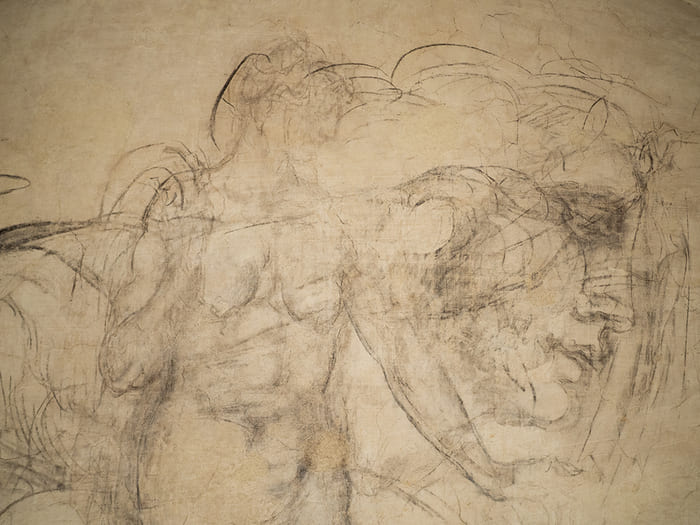
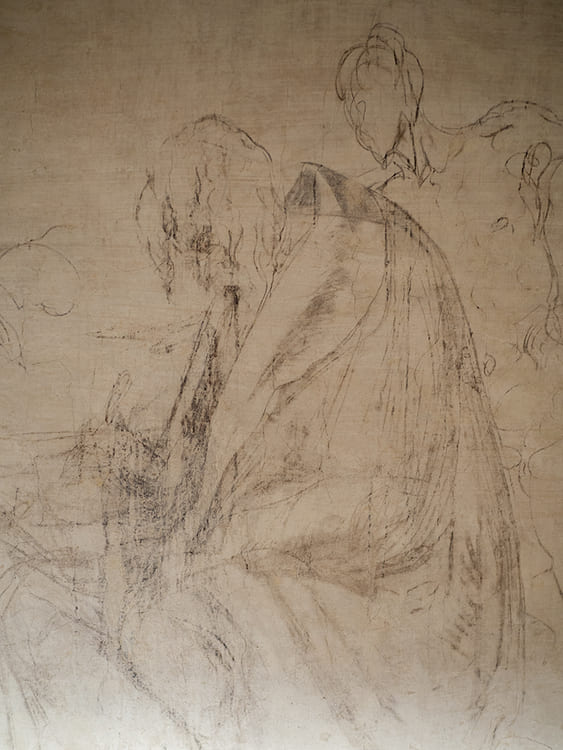
Inside the room, you will find many drawings by Michelangelo himself and some by the members of his workshop or other artists. Many of them refer directly to the sculptures inside the New Sacristy. They were made as preparatory drawings and sketches, studies of ideas that were later reworked and improved.
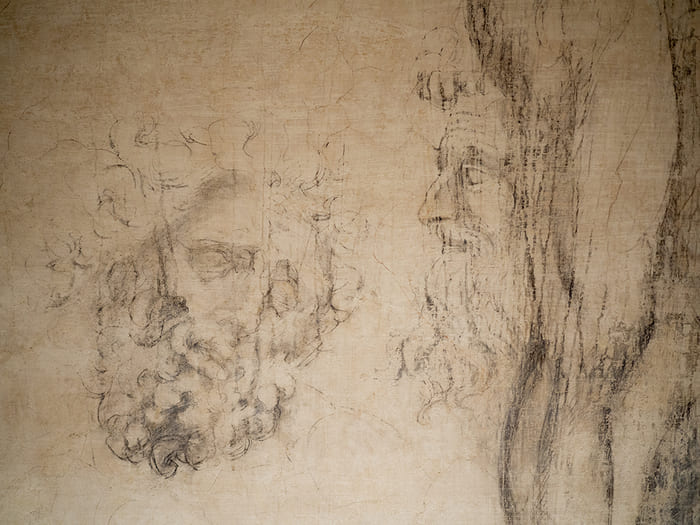
This kind of drawing is the study for the lower part of the body for the statue of Giuliano de’ Medici, Duke of Nemours or the head of an old man, inspired by the ancient statue of Laocoon, discovered in Rome in 1506, that became a preparatory drawing for the head of Saint Cosmas sculpted by Michelangelo’s pupil, Giovanni Angelo Montorsoli.
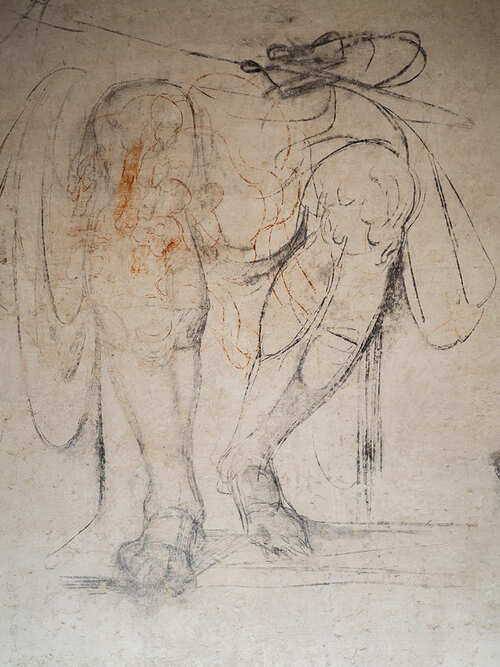
Other drawings in the room include studies of legs and body parts, a study of a head, and a figure of an elderly Saint Matthew assisted by an angel. There are also some satirical images of faces and comic figures.
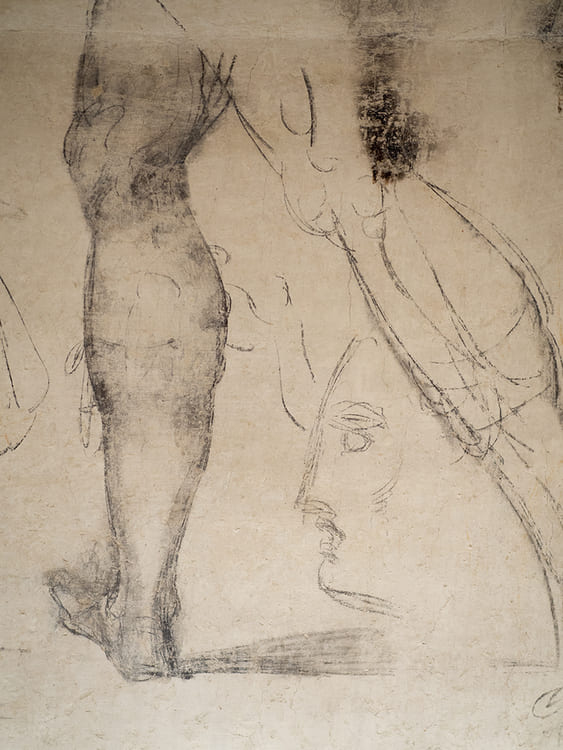
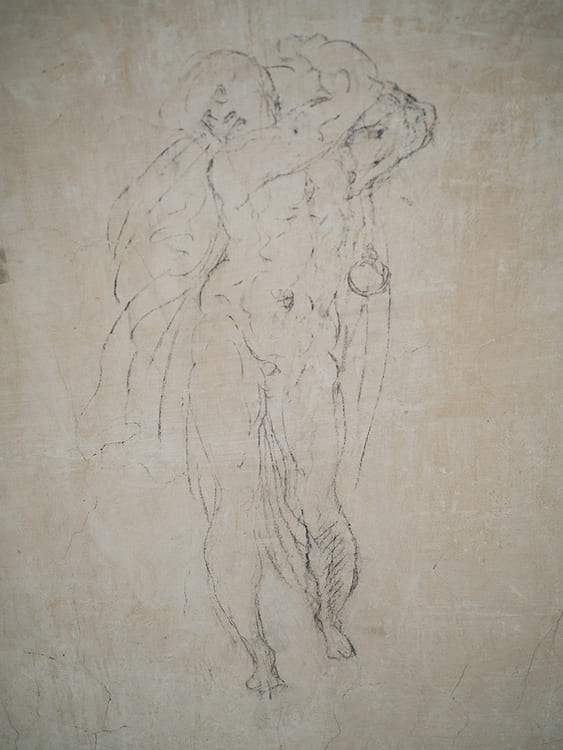
What is interesting is that these drawings, made with charcoal, seemingly so ephemeral, were covered with a layer of egg white, which is a known fixer. It means that Michelangelo wanted to preserve them and make them last.
Visiting Michelangelo’s secret room
Michelangelo’s “secret room” reopened to the public in November 2023.
It is possible to visit the room on Mondays, Wednesdays, Thursdays, Fridays and Saturdays.
The visit is limited to groups of 4 people, and there are only a few slots each day available:
- Mondays and Fridays: at 3:00, at 4:30 and at 6:00 pm
- Wednesdays, Thursdays and Saturdays: at 9:00, 10:30 am, 12:00, 1:30, 3:00, 4:30 and 6:00 pm
Michelangelo’s secret room: tickets and prices
Tickets:
- adults: 32,00 €
- children under 18 years old: 3,00 €
- EU students under 25 years old: 7 €
The tickets can be booked here. The ticket gives you access to the New Sacristy and the Chapel of the Princes, so the whole complex of the Medici Chapels museum.
The connection between Michelangelo’s “secret room” and the Medici
Michelangelo used as his studio the room located underneath the New Sacristy at San Lorenzo during his work in the chapel. The New Sacristy was commissioned from the artist by the Medici pope, Leo X, who was also Michelangelo’s friend from childhood. The pope wanted to glorify through this funerary monument the memory of the four members of his family: his father, Lawrence the Magnificent; his uncle, Giuliano de’ Medici; his brother, Giuliano de’ Medici, Duke of Nemours, and his nephew, Lorenzo de’ Medici, Duke of Urbino. The works in the chapel continued during the papacy of Leo’s cousin, Pope Clement VII. Michelangelo left this project unfinished as he moved out of Florence after Clement’s death in 1534.
Paolo dal Poggetto, the director of the Medici Chapels museum, who assisted in the discovery of the room in 1975, promoted the idea that the room was where Michelangelo tried to hide from the Medici during their attack on Florence between 1529 and 1530. This idea, not confirmed by any documents, is based on our knowledge of Michelangelo’s conflictual relationship with the Medici during the months of the siege.
In fact, Michelangelo was a convinced supporter of Republican government in the city. He even helped the Republic to resist the Medicean attack in 1529, providing projects and plans for the construction and reinforcement of the city walls and bastions around San Miniato Basilica and along the southern part of the city wall in Oltrarno. Dal Poggetto imagined Michelangelo scared of the Medici’s anger once they had conquered the city and had learned about Michelangelo’s help offered to the Republicans.
This captivating narrative, however, is not really plausible.
Where is Michelangelo’s “secret room”?
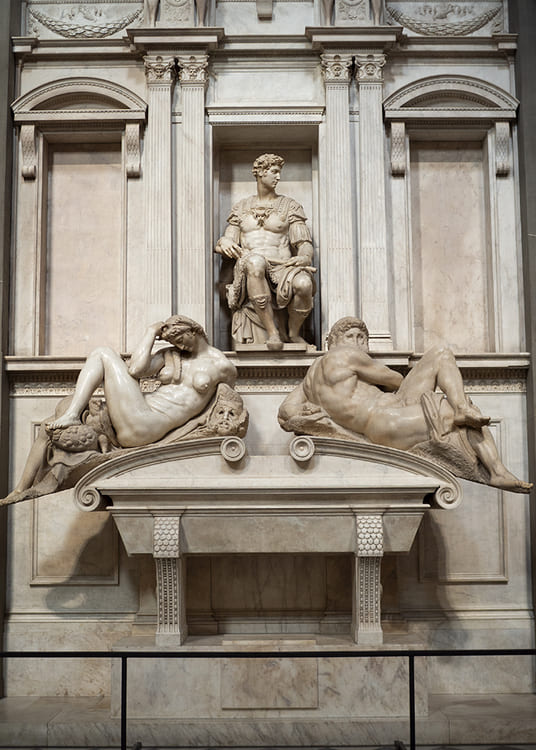
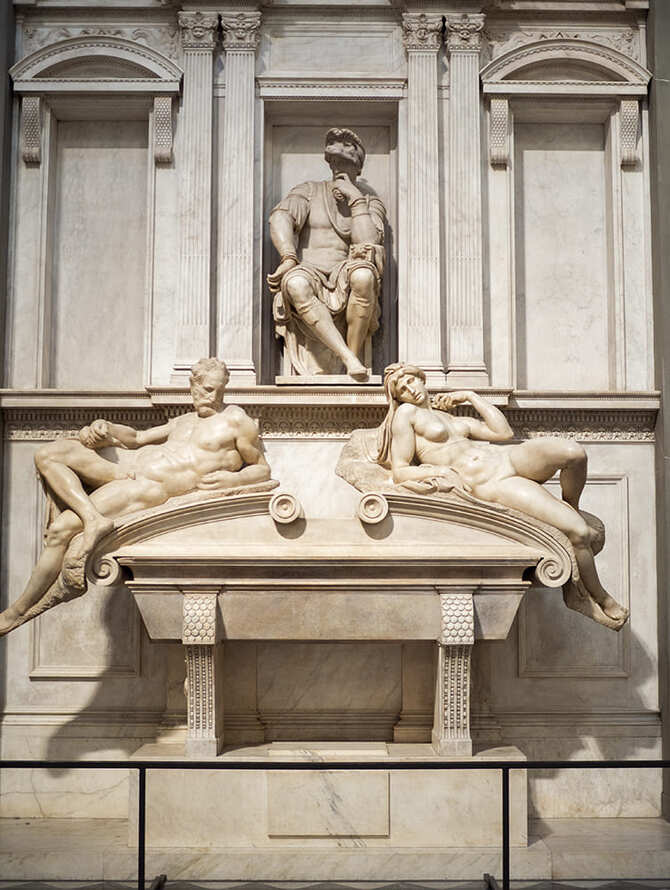
The room is at San Lorenzo Basilica, in the so-called New Sacristy, the funerary chapel designed by Michelangelo for the Medici family. Today, it’s part of the museum complex of the Medici Chapels.
How to book a tour of Michelangelo’s secret room?
Do you want to visit Michelangelo’s secret room on a private tour? Contact us! We can arrange this visit as a part of the Medici in San Lorenzo tour, or as an addition to your city walk in Florence. Together, we can create your custom itinerary that caters to your interests and needs.