

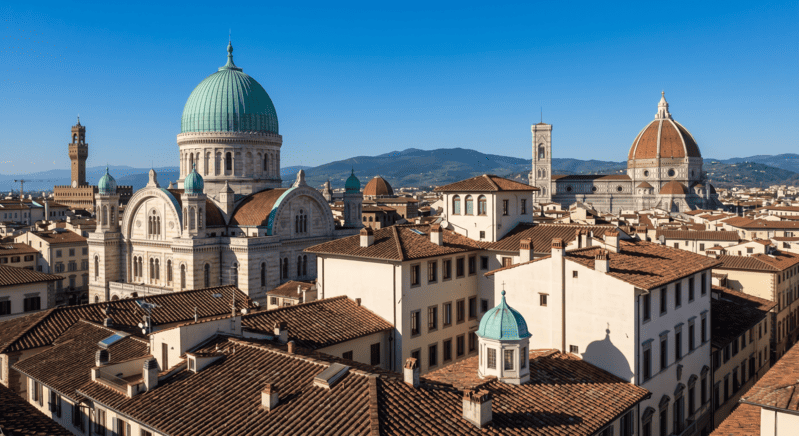
The Jewish Quarter of Florence is one of the most fascinating yet often overlooked areas of the city. Exploring it means stepping into a layered history of integration, cultural contribution, tragedy, and rebirth. The Florentine Jewish community has played a fundamental role in shaping the city’s social, artistic, and economic identity, with contributions from architects, writers, poets, and entrepreneurs that helped define Florence as we know it today.
From medieval banking families to Renaissance-era transformations, from the creation of the historical ghetto to the modern vibrant neighborhood, this area tells a story that is deeply intertwined with the history of Florence itself.
The history of the Florence jewish quarter
The presence of the Jewish community in Florence dates back to the early centuries of Florentine history.
The discovery of some tombstones in the underground cemetery near the church of Santa Felicita attests the ancient presence of Jews in Florence, already a flourishing market point in Roman times.
The first Jewish settlement also took place there: in via dei Ramaglianti, formerly “via dei Giudei” (the street of the Jews) was hosting the oldest Synagogue of the city.

However, we can consider the Florentine Community established only in 1437 when Cosimo the Elder de’ Medici stipulated with Abramo di Dattilo an agreement that allowed the establishment of four Jewish banks in the city. This marked the beginning of a strong economic relationship between Jewish families and Medici Florence, where Jewish citizens actively contributed to trade, finance, and urban development.
However, this relationship changed over time. Under Lorenzo the Magnificent and later during the rule of Cosimo I, increasing restrictions and waves of immigration from the Iberian Peninsula led to growing tensions. The situation culminated in 1571, when Grand Duke Cosimo I de’ Medici established the Florentine ghetto, fundamentally reshaping Jewish life in the city.
The historical Jewish Ghetto of Florence
The Florentine ghetto was created in 1571 and located in the heart of the historic center, between today’s Piazza della Repubblica and the Baptistery. It was a closed, controlled area where Jewish families were forced to live. Around 500 Florentine Jews lived in the ghetto at the very beginning.

The architectural design by Bernardo Buontalenti, reused existing buildings and transformed the area into a fortified, enclosed space. Inside the ghetto there were:
- 89 apartments,
- 33 shops,
- warehouses,
- two synagogues,
- a slaughterhouse,
- squares,
- and a well.
The gates were closed at night, restricting movement outside the area.
The living conditions in the seventy-two apartments of the original Ghetto were very different, following the diversity in the previous buildings, from working-class homes to palaces. Their height also depended on the previous structures, even if few new floors were added during construction. At the centre of the square at the heart of the Ghetto there was a well, perfectly located for the needs of the shops, especially the slaughterhouse and the butcher. Many other buildings had their own wells.
The resident population could only carry out two types of trades: the lending of money and the trade of second-hand cloths and clothes (it seems a small trade, but in reality it had a very high volume of business and, above all, involved unavoidable ties with the rest of the city’s commerce).

From a description of 1708 we know that the “old ghetto” consisted of eighty-nine apartments and 33 shops and warehouses, to these others were added and, twenty years later, the apartments had risen to one hundred and fifty-one with more than fifty shops and warehouses. In the beginning of the 1700s, 105 jewish families, in fact, were living out of the ghetto, because there was not enough space inside, in accommodations that appear to have been quite luxurious, with advanced amenities and servants, the result of a process during which the wealthier families of the Jewish community moved out from the Ghetto in search of better quarters. Cosimo III then decided to add the second two blocks to the Ghetto, creating the “New Ghetto”.
But, the new apartments and shops were not deemed very appealing: two years after the conclusion of works, many of these were still unoccupied, «lacking useful spaces such as storage rooms for firewood, pantries, laundry rooms». The Jews complained that «every apartment is made of an entry, one living room, a kitchen, and two bedrooms». Even if rent rates were competitive for the Florentine market, «30 scudi on the first and second floor, 28 scudi on the third, and from 18 to 22 for the forth, with more than 95 steps to climb», many families decided to remain in their expensive apartments outside the Ghetto, and pay an average of 60 scudi.
From these and may other informations we can see the obligation to reside in the Ghetto was more formal than effective already a century after its first establishment, that Jews could still enter and leave it with a certain freedom and that there were no “moral” or “security” objections to their life outside the spatial limits officially dedicated to them.

Today’s Florence Jewish quarter
With the arrival of the Ausburg-Lorraine family as the new Dukes, the definitive affirmation, in their legislation, of the ideas of the Enlightenment and, above all, their economic re-organization of the State, the Ghetto became more of a burden than an asset for the ducal family: in 1775, the Scrittoio decided to sell out all properties of the Ghetto. A public auction was organized, but the deteriorated conditions of the buildings discouraged possible investors. Only after important consolidation works were carried out between 1777 and 1779 was the Ghetto sold for 34,584 scudi in 1779. Two Jewish families, the Finzi and the Della Vida, purchased the majority of the properties.
The census of 1841 listed 1543 Jews living in Florence: 103 families in the Ghetto Vecchio and 141 in the Ghetto Nuovo. The average number of people living in one apartment was more than eleven, a clear indicator of the low level of living conditions. In the middle of the nineteenth century, the area of the ghetto was clearly deteriorated. Many Jews had moved outside of the area, and a new monumental synagogue was to be built between 1874 and 1882 in a recently developed area of the city.
Following the demolition of the historical ghetto, the center of Jewish life moved to the Sant’Ambrogio area. In 1882, shortly after Jewish emancipation in unified Italy, the community built a new synagogue that became the spiritual and cultural heart of modern Jewish Florence.
Today, the Jewish Quarter is a living neighborhood where history and contemporary culture coexist. Visitors can explore religious heritage sites, museums, traditional restaurants, and memorials that preserve the memory of past generations.
Florence jewish quarter: exploring the area
Walking through the Jewish Quarter today means discovering a blend of architecture, memory, and everyday life.
Florence jewish quarter: synagogues, kosher cooking and cemeteries
The Synagogue
The main landmark of the district is the Great Synagogue of Florence, inaugurated in 1882, one of the most impressive synagogues in Europe. Built in Moorish Revival style, it features a striking green copper dome and richly decorated interiors with Arabic and Moorish-inspired wooden patterns.
It remains an active place of worship and also a symbol of Jewish presence and resilience in Florence.
The need for a Temple suitable for the Florentine community began to be discussed as early as the end of 1847, but the difficulties of having sufficient sums blocked any initiative for several decades. Decisive, in 1868, was the will of Cav. David Levi, who linked his assets to the construction of a “monumental temple worthy of Florence”. In November 1870 the architects Falcini, Treves and Micheli were commissioned with the project.
The project was influenced by the search for a Jewish identity that would show itself to the outside world also through an architecture with its own characteristics. The overall result, read from the perspective of the Eclecticism of the late nineteenth century, was something new, which combined Moorish, Romanesque and Byzantine elements.
The Jewish Museum of Florence
Inside the synagogue complex you will find the Jewish Museum of Florence, which is arranged over two floors and showcases objects of daily life, religious rituals, and private devotion.
The first section documents the history of the Jews in Florence over the centuries and their relationship with the city. In the display cases are furniture, textile, and silver, used for synagogue ceremonies between the end of the sixteenth and nineteenth centuries.
On the second floor, in a room with a beautiful view on the inside of the temple, there are objects and furnishings of domestic and private devotion, illustrating the highlights of the festivities and religious life of a Jew such as birth, marriage and religious ceremonies. Many of these items are gifts from Jewish families who wanted to testify to their attachment to the Community. Important figures in the community include the knight David Levi, who left his fortune to construct the building of the synagogue, and that of Rabbi Shmuel Zvi Margulies, of Polish origin, who renewed the Italian Rabbinical College and brought it to Florence.
The museum tells the story of Jewish life in Florence through personal artifacts, ceremonial objects, and documents that illustrate celebrations such as weddings and funerals. Many of these items were donated by local families, making the exhibition deeply personal and historically valuable.
Kosher cooking
Food is an essential part of experiencing the Jewish Quarter. Today, visitors can explore traditional kosher-inspired cuisine in several local restaurants.
Ruth’s is the historic restaurant of Jewish cuisine in Florence, a historic place for kosher vegetarian and fish cuisine, immediately next to the magnificent gate that closes the garden of the Synagogue. Tomas, body and soul of the restaurant, has Czechoslovak origins, has lived in Florence since 2001 when he took over the restaurant, but has been in Tuscany since 1982.
For some years now, right in front of the historic Ruth’s, the Florentine branch of Ba’Ghetto, a historic restaurant in the ghetto of Rome, has opened, bringing the experience of Judeo-Roman and Middle Eastern kosher cuisine to Florence. Here the rules of kashrut are strictly followed, under the control of the Jewish Community of Florence.
These restaurants help keep culinary traditions alive while adapting them to contemporary tastes.
In Florence there are also numerous shops selling both fruit and vegetables and kosher butchers, mainly concentrated in the neighborhood, one even directly inside the historic market of Sant’Ambrogio. In most cases it is required to book food, because these are “mixed” establishments that offer to host a dedicated section.
Shoa
The Florentine Jewish community had always been, as we have seen, well integrated into the city’s society, so much so that in the Jewish cemetery of Viale Ariosto, there are many monumental tombs, with sculptures and references to romantic iconographies, completely different from those of Jewish tradition and observance.
A Jewish architect had been commissioned to design the façade of one of the major churches, the Basilica of Santa Croce, and many members of the Community had successful businesses, guesthouses, workshops, or taught in schools and even at universities.
Unfortunately, even in Florence the racial laws of 1938 changed things and, even worse, during the Nazi occupation, most of the members of the Community were rounded up and deported to Italian concentration camps and from there to those of extermination in northern Europe.
In Florence, the ancient hospital of San Paolo in Piazza Santa Maria Novella went from being a public school to a collection center for the rakes who were taken from there to the Santa Maria Novella station, where – on platform 16 – the translators for the Fossoli camp were waiting for them.
Even today, those who go to take the regional trains that lead to eastern Tuscany and Umbria pass in front of several license plates, some very evident, which recall that horror, even if, unfortunately, in the daily hurry, few stop to read. The massive deportation happened during the last months of 1943 and the beginning of 1944. In total, 9000 Italian Jews were deported or killed, more than 500 of them were from Florence.
Stumbling stones and Holocaust remembrance
Since January 2020 Florence has been participating in the international project of the “Stumbling Stones” (Stolpersteine) launched by the German artist Gunther Demnig as a permanent memory of those who lost their lives during the Holocaust.

Brass squares the size of a cobblestone (10×10 cm) are set in the pavement in front of the home of the victims of deportations to concentration camps, engraved with their names, the dates of their capture and, when there are any, those of death. Today, Florence hosts more than 130 stones and more of them are being added year after year.
They owe their name to their goal of “tripping” passers-by and reminding them of what happened right in that part of the city, during the Nazi-Fascist occupation.
It should be noted that, rightly, the date of death does not bear the wording “died in”, but that of “murdered in”, underlining, in the reader, the cruelty and futile inhumanity of the gesture that condemned millions of people to a horrendous death.
Discover the Florence Jewish Quarter on a guided tour
Discovering the Jewish history of Florence on a guided tour is the best way to fully understand the ties that have always linked Florence with its Jewish community. A knowledgeable guide can connect the dots between the Medici period, the ghetto era, emancipation, and modern Jewish life in Florence.
A guided experience allows visitors to:
- Understand the evolution of Jewish life in Florence
- Explore hidden historical locations in the old ghetto area
- Visit the synagogue and museum with detailed explanations
- Learn about Holocaust memorials scattered throughout the city
- Discover cultural and culinary traditions still alive today
Are you looking for a local guide who can bring Florence’s Jewish Quarter to life with stories, context, and hidden details you won’t find on your own? Contact us! We’ll be happy to organize the perfect visit for you!