

Are you planning your trip to Florence and you want to discover the city through its art? Here’s a complete guide for you, a list of the artworks you absolutely cannot miss while visiting this extraordinary city.
The art preserved in Florence tells a fascinating story of the birth of Renaissance art and culture. Florence is an open-air art laboratory. Here, you can observe the evolution of Renaissance style, from its early decades during the time of Donatello, Masaccio, and Brunelleschi, to its maturity in the art of Michelangelo, and finally to the late phase known as Mannerism in the works of artists such as Jean de Boulogne and Pontormo.
Let me take you on a walk through Renaissance art, exploring the 10 most important artworks preserved in Florence.
What is the most famous artwork in Florence?
For many people, the most famous artwork in Florence is the monumental statue of David, carved by Michelangelo between 1501 and 1504. The original sculpture is preserved at the Galleria dell’Accademia in Florence. Meanwhile, in Piazza della Signoria, you can see its replica.
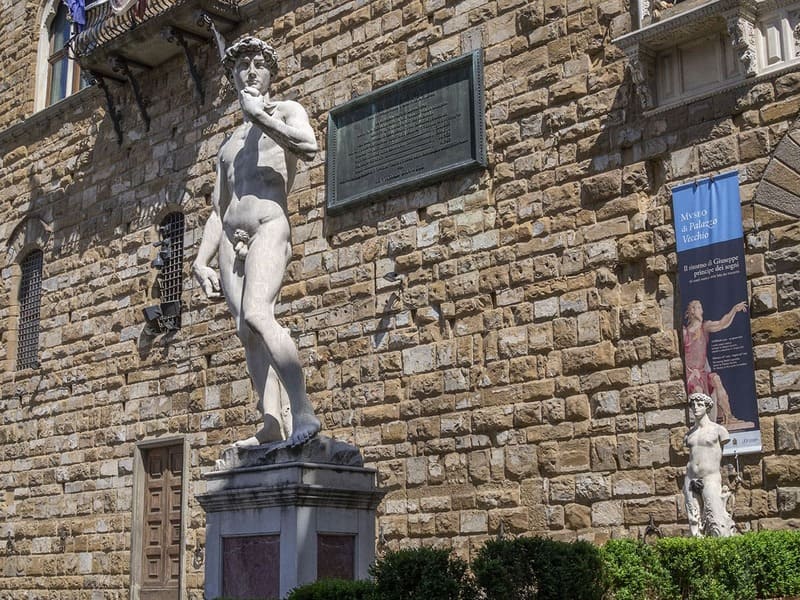
The statue was originally commissioned by the cathedral authorities, as it was supposed to decorate the roof of one of the apses of Santa Maria del Fiore. However, David never made it to the roof. Instead, it was positioned in Piazza della Signoria, in front of the entrance to Florence’s city hall, where it stood for more than 300 years.
In 1873, the statue was moved to the Accademia Gallery because, even at that time, protection was necessary. The sculpture had suffered damage from the elements,—rain and wind,—after being exposed for so long.
David represented a breaking point for the evolution of Renaissance art. With this single artwork Michelangelo reaffirmed the return to the models of classical art: classical proportions, ideals of divine perfection and virtue expressed by nudity. Incredibly detailed representation of the human body proves Michelangelo’s anatomical studies. David quickly became a political symbol as well, as it was read by the Florentines as representation of their heroic victory against the Medici family, obtained with the Medici’s exile in 1494. David, therefore, is not only an artistic masterpiece, but a symbol of Florence itself.
Florence artwork: here the top 10
1. The Holy Trinity by Masaccio
You simply cannot visit Florence without seeing the famous Holy Trinity, a fresco painted between 1425 and 1427 by Masaccio inside the Dominican church of Santa Maria Novella.
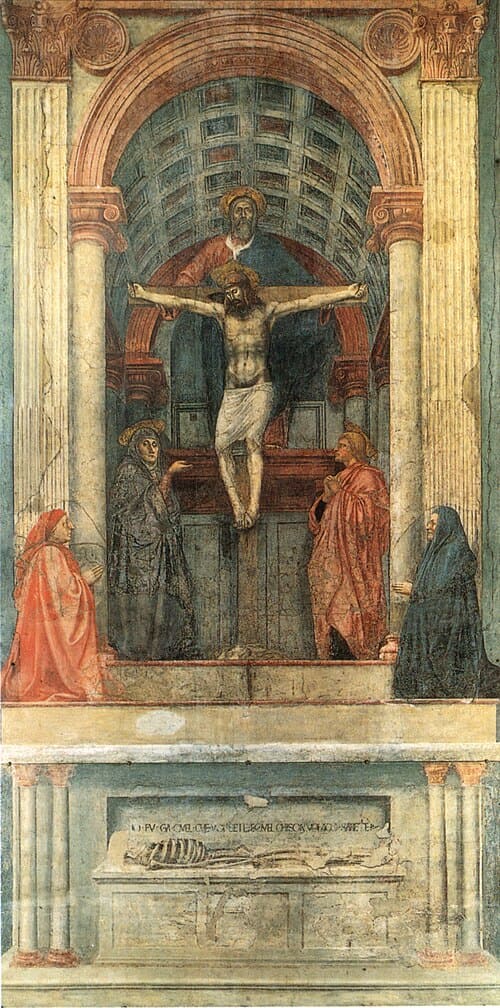
The Holy Trinity is the first fresco in Western art painted with a coherent and correct use of linear perspective, a drawing method that allows a precise projection of depth on a flat surface.
On the fresco Masaccio represented a fictive chapel in which he placed God the Father standing on the altar, holding the cross with the body of Jesus in front of him. Between the two figures hovers the dove of the Holy Spirit. Under Jesus’ cross stand John the Evangelist and the Virgin Mary, while outside the chapel kneel the two commissioners of the work.
The perspective scheme of the Holy Trinity was probably developed together with Brunelleschi, who is considered the inventor of this revolutionary drawing method.
2. Donatello’s David
In 1440 Donatello cast a statue of David, commissioned by Cosimo the Elder de’ Medici. The statue was placed by Cosimo in the courtyard of the Palazzo Medici. With this artwork Cosimo not only wanted to picture himself as an illustrious patron of new artistic culture, but he also sent a political message, showcasing himself as a defender of republican freedoms in Florence.
Cosimo wanted to portray himself as the protector of Florentine independence.
Donatello’s David was the first of the Renaissance depictions of this biblical hero inspired by the ancient ideals of virtue represented through nudity. Decades before Michelangelo, Donatello envisioned his David naked as an ancient deity.
Donatello’s David is represented as a young, naked man. He holds a sword in one hand while Goliath’s head lies under his feet. He looks at the spectator with a fierce glance showing off his courage and virtue.
The statue was seized by the people of Florence in 1494, when the city opposed the Medici family. The Florentines attacked and plundered the Palazzo Medici, taking away Donatello’s David and his Judith and Holofernes.
The family was sent to exile, while the two statues, as symbols of the Republican freedom, were placed at the Palazzo dei Priori. Judith was positioned at the entrance to the palace, while David decorated the courtyard. For the people of Florence this removal symbolically represented the restored freedom. As David and Judith were freed from the oppression of the Medici family, Florence again enjoyed its Republican liberty.
3. The Gates of Paradise
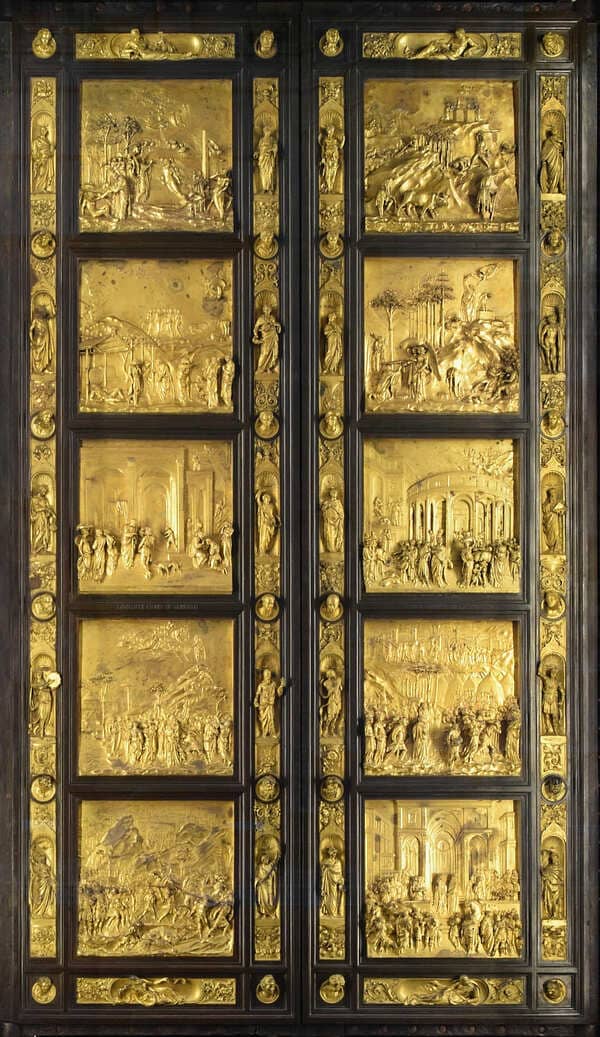
One of the most meaningful masterpieces of the Early Renaissance art in Florence are the Gates of Paradise. This set of the gilded bronze doors that once decorated the Florence Baptistery, was designed by Lorenzo Ghiberti. Today, the originals are housed in the Cathedral Museum, while the copies remain on display at the Baptistery.
Ghiberti worked on the execution of the doors for 27 years, between 1425 and 1452.
The 20 big panels that decorate the both sides represent the Old Testament scenes. The narrative starts with the Genesis and it carries on with the stories of Cain and Abel, Noah, Abraham, Jacob, and Joseph. Subsequently, Ghiberti pictured Moses receiving the Ten Commandments, the Israelites marching around Jericho trying to demolish the city’s walls, the story of David and Goliath, and the meeting between King Solomon and the Queen of Sheba.
The most innovative part of Ghiberti’s design remains the use of linear perspective, thanks to which the artist managed to create the illusion of depth and he built the setting for his stories to unravel. Inspired by Donatello’s stiacciato, Ghiberti also masterfully played with the depth of the relief, creating some figures almost fully three-dimensional, while depicting other elements as very flat in the background. Thanks to these two innovations Ghiberti created fantastic setting for his protagonists: gardens, mountains, cities, where the Biblical stories come to life.
The Gates of Paradise suffered severe damage during the catastrophic flood in Florence on November 4 1966, prompting their removal from the Baptistery. A lengthy restoration was completed only about 12 years ago. Since then, the doors have been on display at the Cathedral Museum.
4. The Birth of Venus by Sandro Botticelli
For many visitors, the most beautiful among the famous paintings in Uffizi is The Birth of Venus, painted by Sandro Botticelli during the 1480s. The painting once belonged to Lorenzo di Pierfrancesco de’ Medici, a member of the Medici family, who also owned another majestic work by Botticelli: the famous Primavera.
Botticelli’s The Birth of Venus, illustrates the mythological story of the newly-born goddess Venus arriving at the island of Cyprus. Venus stands on a giant shell as she approaches the Cypriot shore. An Hora waits with a cloak ready to cover Venus’ nudity, while the two winds, Zephyrus and Aura, blow warm air and scatter flowers to welcome the goddess.
Botticelli’s composition was inspired by Poliziano’s Stanze per la giostra, a poem written in the vernacular Florentine, in which Poliziano elaborated the ideas originating from the Roman mythology. Poliziano wrote:
Vagheggia Cipri un dilettoso monte,
Che del gran Nilo i sette corni vede
Al primo rosseggiar dell’orizzonte,
Ove poggiar non lice a mortal piede;
Nel giogo un verde colle alza la fronte,
Sott’esso aprico un lieto pratel siede,
U’ scherzando tra’ fior lascive aurette
Fan dolcemente tremolar l’erbette.
[…]
Con tal milizia i tuoi figli accompagna,
Venere bella madre degli Amori:
Zefiro il prato di rugiada bagna
Spargendolo di mille vaghi odori,
Ovunque vola veste la campagna
Di rose, gigli, violette, e fiori:
L’erba di sua bellezza ha maraviglia
Bianca, cilestre, pallida, e vermiglia.
Trema la mammoletta verginella
Con occhi bassi onesta, e vergognosa,
Ma via più lieta, più ridente e bella
Ardisce aprire il seno al sol la rosa:
A delightful mountain lords over the mountain of Cyprus,
it faces the seven mouths of the Nile and
the first reddening of the horison; there no mortal
foot is allowed to tread. Between its shoulders
a green hill raises its forehead, a sunny and happy
meadow lies below, where gentle breezes,
playing among the flowers, make the grass sweetly
tremble.
[…]
This army accompanies your sons, fair Venus,
mother of the cupids, Zephyr bathes the meadow
with dew, spreading a thousand lovely fragrances:
wherever he flies he clothes the countryside
in roses, lilies, violets, and other flowers;
the grass marvels at its own beauties, white, blue, pale, and red.
Chaste and modest, the virgin violet trembles
with downcast eyes; but the rose, many times
happier, laughing and lovely, dares to open her
breast to the sun; […].
Angelo Poliziano, The stanze of Angelo Poliziano, Amherst 1979, pp. 37-41.
Another crucial source of inspiration for the painter was Greek and Roman sculpture. In fact, Botticelli pictured Venus copying the ancient pose known as the Venus Pudica. You can see that the goddess modestly covers her intimate parts and her breast with both arms. This gesture symbolizing modesty originated from the sculpture by the Greek artist Praxiteles and became an often repeated model for the later representations of Venus.
The novelty of the Birth of Venus is not limited to its meaning inspired by the Classical mythology. Also from the technical point of view, this painting represents an experiment, as it is painted on canvas. In fact, canvas, was not a common support for painting in Florence at that time, as the local painters preferred wooden panels. Wood was for a long time considered far more resistant and durable than canvas.
If you want to see this masterpiece, you absolutely must visit the Uffizi Gallery in Florence. Book a guided tour if you wish!
5. Michelangelo’s Tondo Doni
At the Uffizi Gallery, you can also admire the only preserved finished panel painting by Michelangelo. I am talking about his famous Tondo Doni, painted around 1507 for Angelo and Maddalena Doni.
The painting celebrates the birth of their daughter Maria Nanna Romola and it depicts the Holy Family with Saint John the Baptist. At the center of the composition you can see the Virgin Mary who, with an athletic gesture, turns back to take the newborn Jesus from the arms of Saint Joseph. The twisting and torsion of the figures give the painting dynamic energy and enrich the composition.
Equally striking is Michelangelo’s innovative use of color. The palette of pinks, oranges, and greens was absolutely unprecedented.
Behind the central group, a young Saint John the Baptist approaches the Holy Family. In the background, there i’s a wall with five nude male figures sitting in the backdrop. They probably represent the souls of the Doni couple’s lost children. Before the birth of their daughter, Maddalena Doni suffered four miscarriages and gave birth to four stillborn children, whose souls might be commemorated in this intimate way (Chiara Franceschini, The Nudes in Limbo: Michelangelo’s “Doni Tondo” Reconsidered, in: “Journal of the Warburg and Courtauld Institutes”, Vol. 73 (2010), pp. 137-180.)..
6. Venus of Urbino by Titian
The Venus of Urbino is one of the most celebrated masterpieces preserved in Florence. It was commissioned in 1538 by Guidobaldo II della Rovere, a young successor to the throne of the Duchy of Urbino. The painting possibly refers to the marriage between Guidobaldo and his young wife, Giulia Varano, who was just 11 years old when they married in 1534.
Thus, the Venus of Urbino was likely intended as a kind of visual guide for Giulia on her duties as a wife to Guidobaldo. The painting is rich with symbols referencing female virtues: faith, charity, and hope. The green curtain behind Venus symbolizes hope; the white linen on which she reclines refers to faith; and the red mattress represents charity.
Women at the time were expected to be loyal and faithful wives, symbolized here by the small dog sleeping on the mattress. Meanwhile, Venus’ nudity refers to the sensual aspect of marriage and the societal expectation for women to bear children.
7. Pontormo’s Deposition from the Cross
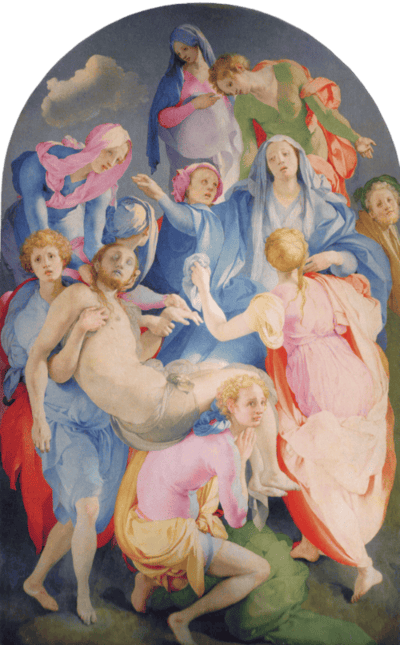
What I love most about Florence is that some of its greatest masterpieces are still freely accessible in its churches. This is the case with the famous Deposition from the Cross by Pontormo, which still hangs today in the Capponi Chapel inside the church of Santa Felicita.
Santa Felicita is located just a few steps from the Ponte Vecchio in the Oltrarno neighbourhood. When you enter the church, the Capponi Chapel is immediately on your right, where you’ll find this important painting.
In this composition, a group of figures carries the dead body of Christ. They appear almost to be dancing, standing on tiptoe, creating the impression that Jesus’ body might tumble down onto the altar below. Pontormo uses bright, translucent colors: blues, greens, and pinks, making this piece a beautiful example of mature Renaissance art, known as Mannerism.
If you’re exploring the area around the Ponte Vecchio, walk a little farther and visit Santa Felicita just to see this extraordinary masterpiece.
8. Michelangelo’s Pietà Bandini
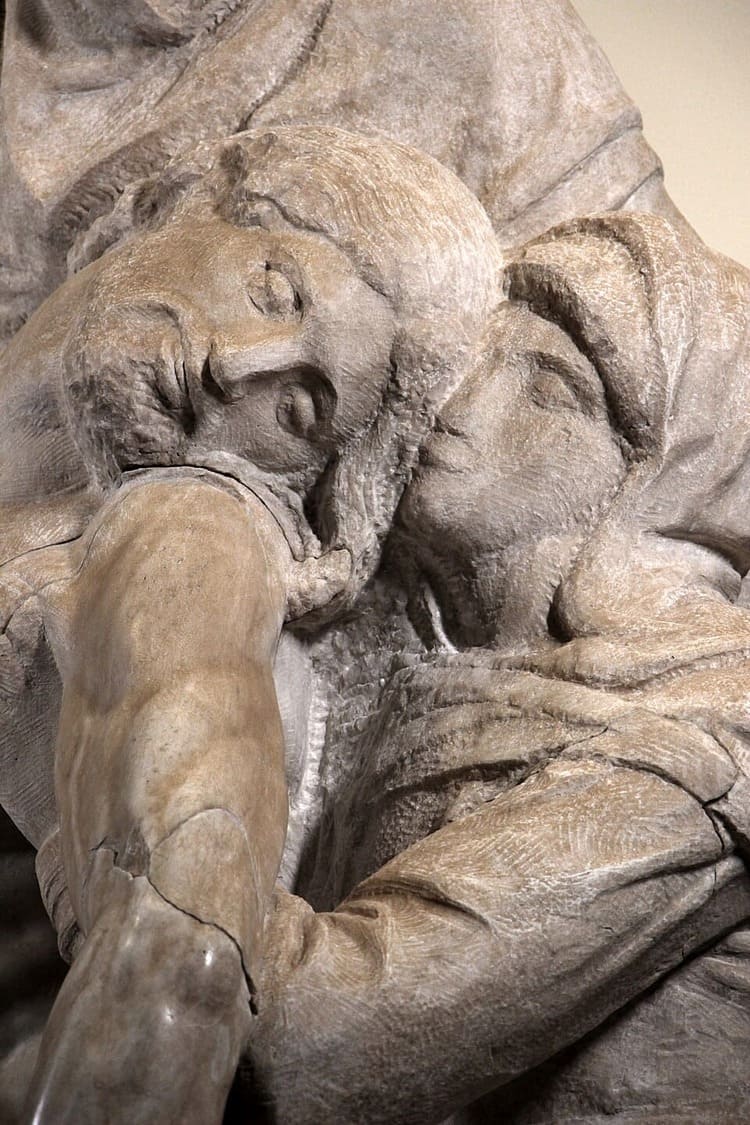
In Florence, everyone seems obsessed with seeing David. Long lines form outside the Galleria dell’Accademia just for a glimpse of this iconic sculpture. Yet there are many other masterpieces by Michelangelo hidden in lesser-known museums. One of them is the intimate Pietà Bandini, one of the last works Michelangelo sculpted while contemplating his own tomb.
In Michelangelo’s original vision, this statue was intended to decorate his funerary monument. That’s why the Pietà Bandini feels so deeply personal and intimate.
In this composition, Michelangelo completely revolutionized the traditional iconography of the Pietà. Traditionally, a Pietà depicts the Virgin Mary cradling the dead body of Jesus. Here, Michelangelo added the figure of Nicodemus, who stands behind Mary and Jesus, gently handing Jesus’ body into the Virgin’s arms.
For the first time, the Pietà became a vertical composition rather than a horizontal one. Michelangelo introduced this dramatic change specifically to feature Nicodemus, whose face is actually a self-portrait of the artist himself.
In doing so, Michelangelo made a powerful, personal statement about his faith. Through Nicodemus, the man who, according to the Gospels, took Jesus’ body down from the cross, Michelangelo declared himself a good Christian, someone who carried the weight of Jesus and his sufferings throughout his own life.
Despite its significance, the Pietà Bandini was left unfinished. At a certain point, Michelangelo began struggling to work on the piece of marble intended for the sculpture. The marble was particularly hard, and one day, overcome with frustration, Michelangelo tried to destroy the statue with a hammer.
Fortunately, the statue was saved. It was purchased by Francesco Bandini, who transferred it to his studio and paid a young artist, Tiberio Calcagni, to complete the work. As a result, there’s a fourth figure visible on the left side of the composition, Mary Magdalene, who was not sculpted by Michelangelo.
Later, the Grand Duke of Tuscany acquired the statue, placing it in the Florentine Cathedral. From there, it eventually joined the collection of the Cathedral Museum in Florence.
9. Perseus by Benvenuto Cellini
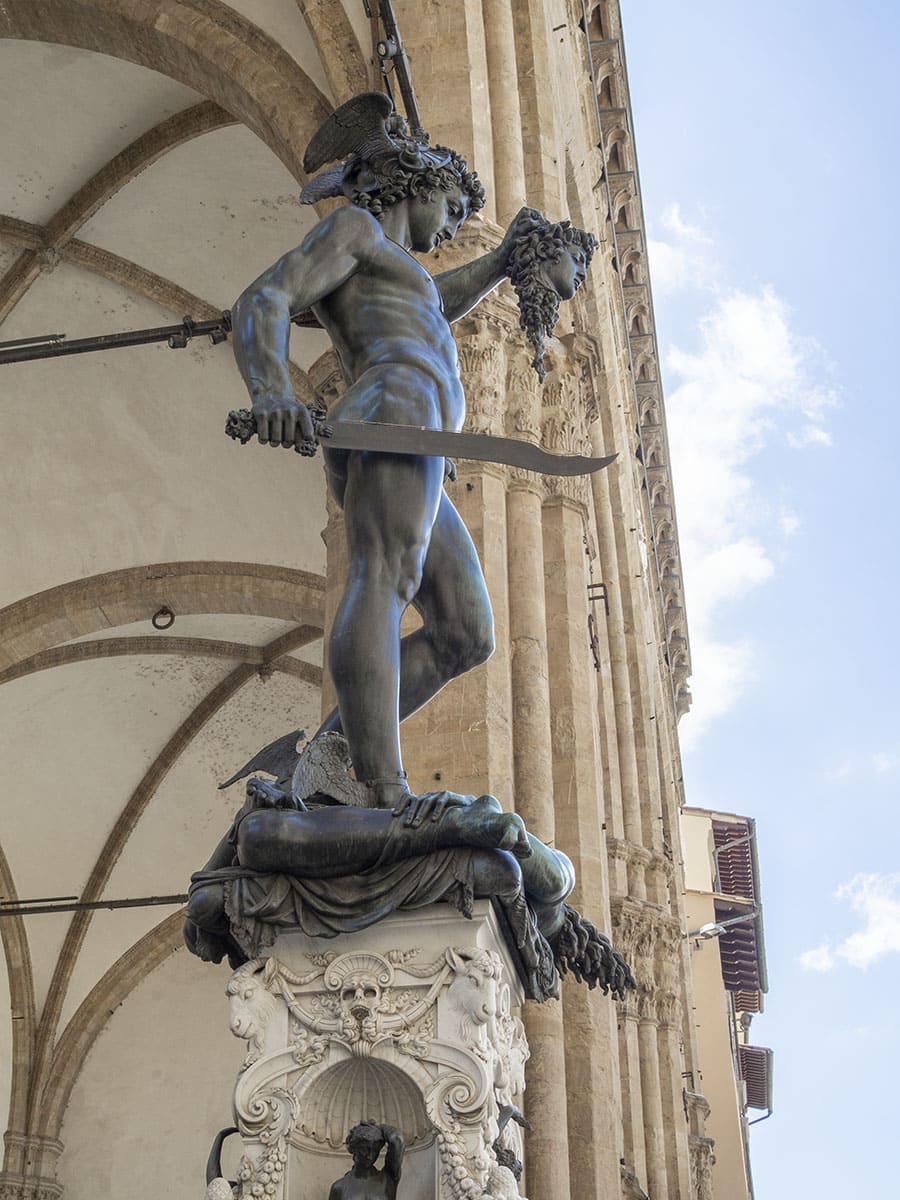
Another Florence artwork, which you can admire for free right in the urban center of Florence, is Perseus by Benvenuto Cellini.
I have to confess: for me, this statue is a kind of painkiller on days when I’m not feeling well. I simply head to Piazza della Signoria, focus on some details of Perseus, and I assure you, all the pain goes away.
This remarkable bronze sculpture was commissioned by Duke Cosimo I de’ Medici. It depicts the mythological hero Perseus, who slew Medusa, the monstrous creature who killed her enemies by turning them to stone with her deadly gaze.
Perseus appears as a young, beautiful man, holding a sword in one hand and Medusa’s severed head in the other. Beyond its stunning artistry, the statue served as a symbol of strength and authority for Duke Cosimo I.
Cellini, who had the opportunity to place this masterpiece in direct confrontation with Michelangelo’s David, aimed to achieve a groundbreaking technical feat. He cast the entire figure of Perseus using just one mold, resulting in a single, seamless piece of bronze.
Cellini tried many times to accomplish this complex casting, and when he finally succeeded, he left his mark by decorating the back of Perseus’ head with his own self-portrait, a small, personal touch hidden in plain sight.
10. The Rape of the Sabine Women
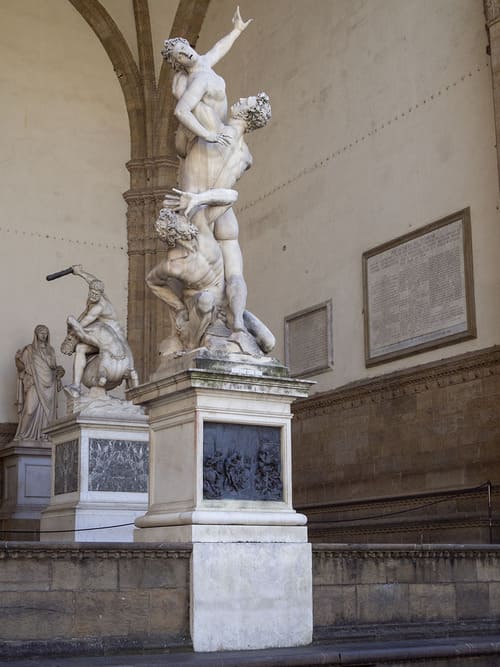
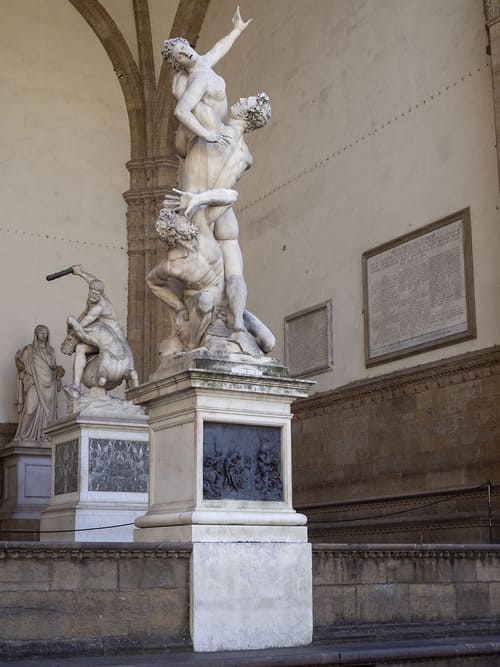
Another important sculpture, still displayed in its original form in Florence’s urban landscape, is the famous Rape of the Sabine Women by the Flemish sculptor Giambologna (Jean de Boulogne).
You’ll find it on the right side of the Loggia dei Lanzi in Piazza della Signoria. This sculpture is an extraordinarily complex composition featuring three figures: a Sabine man struggling to protect a Sabine woman, who is being seized by a Roman at the center of the scene.
All three figures spiral around their own axes, creating a composition reminiscent of a corkscrew.
The story of the Rape of the Sabine Women comes from the early history of Rome, when Romans, unable to find wives, attacked their neighbours and abducted their women in order to get wifes.
Surprisingly, Giambologna didn’t even have this story in mind when he started to work on this composition. His aim, while sculpting this extraordinary sculpture, was to create a composition considered until then impossible to carve. The interpretation of the narrative, which this sculptural group could illustrate was suggested when the statue was ready. Vincenzo Borghini, an intellectual working at the court of the Duke Cosimo I, suggested to the artist that his work pictured the dramatic Rape of the Sabine Women.
For Giambologna, the aim of this work was to design an elegant and intricate composition based on the so-called figura serpentinata, the “snake-like figure.” He wanted to demonstrate to the world that nothing is impossible for an excellent sculptor.
It’s truly astounding that this incredible masterpiece remains on display in its original form in the urban space of Florence.
A walk among the Florence paintings
As you can see, Florence is truly a museum under the sky. Simply strolling through the city streets lets you explore centuries of art and history.
If you’d like to discover Florence in-depth with an expert guide who can explain the evolution of art and introduce you to this fascinating world of art history, contact us. We’d be delighted to design a custom itinerary for you in Florence.