

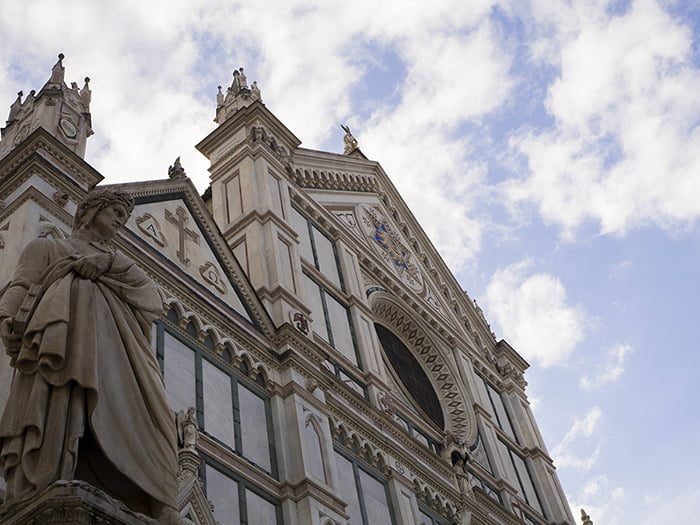
Dante Alighieri, one of the most famous Italian poets and one of the most famous Florentine men. He was first of all a citizen of the Republic of Florence, as a citizen he was actively involved in the politics of the city, in the passions and in its struggle.
He was also an active politician, one of the “priors” of the city – those we can imagine today as government ministers – and as such he was exiled.
This being first and foremost a citizen has powerfully influenced his being also a man of letters and a poet: his reflection on how to balance the power of the church and that of the empire and on how to organize the world are at the origin of his most famous work, the Divine Comedy.
Written from exile, it can be considered his intellectual and spiritual testament and also the first work written in the Florentine vernacular, in order to be read, understood and loved by as many people as possible. The first great “main-stream” literary work of the Middle Ages after the collections of the lives of the Saints.
Dante’s connection to Florence: life and exile
Dante was born in Florence in 1265, at a time when Florence was one of the richest and most powerful cities in Europe.
He was part of the small city nobility loyal to the Guelph Party, but his family was never among those famous and present in ancient documents.
For this reason, we know very little about his youth and education, except that – despite being fatherless – his social status allowed him to study poetry and rhetoric, both in Florence and – probably – in Bologna and to forge friendships and relationships of knowledge and cultural exchange with the Florentine cultural elite.
In 1289 we know, from himself and from documents, that he fought in the Florentine army in the famous battle of Campaldino against the Ghibelline city of Arezzo and shortly after, thanks also to the valor demonstrated, he was able to enter the active politics of Florence.
In 1295 he was in fact in the group of the White Guelphs (the moderates of the time) and a member of both the City Council and the restricted Council of 100 several times and at least three times prior; he was also part of several embassies, including, in 1301 the embassy sent by the city to Pope Boniface VIII to find a political agreement.
In January 1302, when his opponents, the Black Guelphs, came to power, Dante was condemned to perpetual exile on false charges of being a forger and a barterer.
He passed from Forlì to Verona, from Bartolomeo della Scala; in 1306 he was a guest at the Malaspina court in Lunigian, where he wrote his essays on politics and rhetoric.
The distance from Florence and public offices allowed Dante to write the work that gave him perpetual fame: the Divine Comedy (1304-21), a summa of the way in which he, and a large part of the society of the time, saw the world and also of what was the lively, heated, conflictual social and political scene of a rich municipal city.
In 1312 he moved to Verona, to Cangrande della Scala and then to Ravenna where he died of fever, on 14 September 1321, after having refused several times to return to Florence upon payment of a fine.
His remains were never brought back to Florence.
Following Dante’s footsteps in Florence: 6 historical locations of Dante’s presence in town
We have no direct documents on Dante’s properties in Florence, since he lived before the institution of the Catasto (1427) and that, due to exile, many were confiscated.
From a series of tax documents (estimates) and some judicial documents (acts of a legal dispute between the priests of the church of San Martino al Vescovo and the inhabitants of the neighbourhood, regarding the possibility of building in the space of the square near the church) we know that his house and that of his uncle were adjacent and overlooked this square.
Since the church of San Martino has changed size and orientation, it is difficult to orient oneself in today’s Florence, but it should be the houses that flank today’s Piazzetta di San Martino, on the north side, adjacent to the houses of the Giuochi – the actual Casa di Dante Museum.
1. Piazza San Martino and the Chestnut Tower (303)
The tower in Piazza San Martino is an “anomalous” tower for Florence: first of all it is one of the few “public” towers, it did not belong to a family or a faction, but to a monastery and then the whole city. Secondly, it has a curious name “Chestnut Tower”. As a third feature, it is a “small” tower, not even eight meters on each side, because it was born, perhaps as early as 1038, as a defence tower for the monastery of the Badia Fiorentina, donated to it by Emperor Conrad II.
From 1282, the monastery “lent” it to the city to make it the seat of the Priors (we would say of the Government) and ensure its decision-making independence through the possibility of defending themself from the armed threats of the factions.
Its particular name derives from the way in which the Priors voted on the version of the law that they would then present to the council (as we do today in parliamentary committees), using boiled chestnuts, light – without peel – for a no, dark – with peel – for a yes. Moreover, after the vote, you could also have a snack!
Some scholars have also proposed that the term “ballotte“, which in Florentine is boiled chestnuts, could be the origin of the term ballotage, which is usually traced back to the system of “balòte” (gold or silver spheres) in use in the Republic of Venice… who knows!
One last curiosity: the door you see on the ground floor was opened much later, probably at the time of the Priors, because at the beginning, given the defensive function, the only entrances were from inside the monastery, while the portals still visible on the second and third floors from the square, gave access to the wooden balconies of the bertesche.
2. Badia Fiorentina
The Badia Fiorentina, the all-city name for the church of the monastery of Santa Maria, was founded between 960 and 978 by Willa, mother of the Marquis of Tuscany, as a Benedictine monastery of which she herself became the first patroness.
This unusual monastic foundation within a city wall circuit, although close to the Roman walls, is still interpreted by historians as the first sign of the imperial desire to move the political fulcrum of Tuscany from Lucca (and Pisa) to the emerging Florence, in order to redesign the balance of power between the Empire and feudal lords.
To confirm this will, the Marquis Ugo was buried here, after his death on December 21, 1001.
For the Florentines of the past it was very clear that the presence of the Abbey and the tomb of the Marquis had been the beginning of the nascent Florentine power and every year – still today! – they celebrated a mass in suffrage of the illustrious deceased.
Dante himself, in the Comedy, recalls how it was Ugo, with his “beautiful insignia” (the beautiful coat of arms, red and white, symbolic colours of political power since ancient Rome) who knighted many of the progenitors of the noble Florentine families and thus established the renewed prestige and future success of the city.
On August 25, 1373, then, in this very church, Giovanni Boccaccio, the famous author of the Decameron, held the first public reading of Dante’s Comedy, decreeing its recognition as a founding work of the language and culture of Florence.
3. Santa Croce
If you have ever wondered how people studied in Dante’s time, when they had access to a higher culture, here is the answer: they went in search of lectiones, our conferences, held by masters of rhetoric or philosophy. During these lessons, quotes from ancient and modern texts were listened to and then people went to libraries to be able to read them in person.
But there were no public libraries in the Middle Ages. The libraries were mainly those of the great monasteries, in which the “studia“, ancestors of our universities, were also housed.
Dante certainly studied in the library of the Franciscan convent of Santa Croce, one of the largest of the time, and listened to the lectures of the masters of the Franciscan “studium“.
Today, most of those manuscripts have flowed, at the behest of the Lorraine Grand Dukes, into the public libraries of Florence that preserve ancient manuscripts: the Laurentian Library and the Riccardian Library.
4. Bargello and the first portrait of Dante
In 1255, the Comune of Florence had two main magistracies: the Podestà, with executive powers, and the Capitano del Popolo, with powers similar to a chief of police, added to the judiciary. Both magistracies were held by people from outside Florence, to preserve their neutrality, but neither of them, however, had a palace in which to exercise its functions: they were hosted, in turn, by various families or institutions, which made their neutrality no longer taken for granted.
In 1255, in fact, the Municipality of Florence decided to build the first real public palace in the city, and to do it quickly: it chose a space in front of the place where the first Florentine public power had settled, just in front of the Badia, where the Marquis of Tuscany rested, bought a series of houses and towers, and surrounded them with a new façade, coming to create the external enclosure of the Palace that will be the Bargello.
The Bargello, therefore, which takes its name from the first police officer, the Bargello, in fact, is, initially, both a palace of power, a court, and a scaffold for “special” prisoners, and – precisely for this reason – has its own chapel, dedicated to the story of Mary Magdalene, the first penitent of Christianity.
Many art historians attribute the frescoes that decorate this chapel to Giotto‘s Florentine workshop and claim that the work had begun as early as 1333 and ended in the second half of 1337, a few months after Giotto’s death.
It is extraordinary to see how Dante, who took some of his speaches probably in the halls of the palace and then died in exile, far from the city just over a decade earlier, finds a place, with what is considered his oldest portrait, among the saved of the Last Judgment frescoed in the chapel and how the Inferno represented here already recalls the description that the poet makes of it in the Comedy: the way in which Florence, through literary honor, reclaimed the authorship of Dante’s work and claimed his citizenship.
5. The Baptistery
For Dante, the Baptistery is a metaphor for Florence: it was there that the life of every Florentine began, as a citizen and as a Christian, including his own; there were the power and wealth of Florence, expressed in the marbles and in the mosaics of the dome, which he had seen growing during all his Florentine years as an adult.
There he had been a hero for a day, saving a child who had been stuck in one of the pools of the baptismal font – as he reminds us in the Comedy. There he wanted to return, to see his “bel San Giovanni” and to receive the laurel wreath of the poets.
And it was also there, perhaps, that he was influenced by the blue Satan devouring the damned, a mosaic of the dome that he must have had the opportunity to observe many times, and which, with its expressive force, may have inspired him in the construction of his famous and now irreplaceable Inferno.
6. Santa Maria Novella: Chapel of Strozzi di Mantova
If Dante studied in the library of Santa Croce, the other great basilica of the mendicant orders, Santa Maria Novella, preserves the first testimony of how the representation of Hell he gave in the Comedy quickly became the image that the name of that place projected in the minds of the men of the time.
On the left side of the transept, raised above the floor of the church, is the Strozzi chapel of Mantua, built between 1340 and 1350 in honour of St. Thomas Aquinas and later frescoed (1351-57) by Nardo di Cione, brother of Andrea Orcagna.
On its walls were frescoed the Last Judgment, with Christ the Judge, around the stained glass window, and Paradise (to the left of those who enter, but to the right of God) and Hell.
The Inferno is frescoed neatly divided into seven registers, along which are arranged places, fauna and types of the damned taken directly from Dante’s text: we see the Limbo, the boat with which Charon gathers the souls of the condemned, Minos and Cerberus, Paolo and Francesca tossed by the wind of human passions, the heretics who burn inside their tombs, Ulysses enveloped in flames for having hatched the deception of the horse that made Troy fall. The great Lucifer devours the traitors, Judas Brutus and Cassius, while in the deepest part of Hell which is frozen, the traitors of their relatives, their homeland, their guests and benefactors suffer for eternity.
Dante and the 19th century: 4 sights to discover Dante’s legend in Florence
In the tiring years in which Italy was born as a state, bringing together a thousand different souls, one of the efforts that was immediately put in place was to decide which of the infinite dialects (when they are not real languages) spoken by the people of the boot should become the language of the new nation.
The Florentine was chosen precisely because of Dante, and the other two “illustrious Florentines”: Petrarch and Boccaccio.
Dante had been the first to write an essay on the superiority of the Florentine vernacular over all the others and of these over Latin, and above all on the rules that a language had to follow to be the “right” one for all Italians (yes, centuries before political Italy, writers and artists already opened up to Italy as a cultural unit): it had to be used by the most famous and appreciated among the literati, religious and politicians, to be understood by everyone without ever falling out of tone.
Not easy! Yet he used it for his Comedy, Petrarch made it famous in the church and in the courts, Boccaccio wrote both poems and essays, and the first great collection of short stories from all over the country.
So when Boccaccio was chosen, in the Rinascimento, as a linguistic model, the fact that he exalted Dante and his Comedy made the Florentine poet the father of the Italian language.
And as such it was celebrated from the moment when Italy was truly a single state, with the verses of the Comedy studied and related to various Florentine buildings and eternalised on the tombstones that still stand on those walls, commissioned by Isidoro del Lungo.
Dante’s house museum
On the occasion of the choice of Florence as the temporary capital of the Kingdom of Italy, it was decided to buy, restore and transform the Alighieri houses into a museum, among which there was to be the one where Dante had lived, overlooking the square of San Martino.
Postponed due to the transfer of the capital to Rome, the project only materialized in 1911, when the houses in the area that retained a more medieval appearance were chosen and those that hid the view were demolished, creating the small square that today opens near the so-called “House of Dante”.
Today the restored building houses the “Casa di Dante museum” which, with a mainly virtual and interactive layout, illustrates the main phases of the poet’s life and his relations with the medieval city.
Chruch of Santa Margherita dei Cerchi – Dante and Beatrice’s church
Near the Alighieri houses are the small church of Santa Margherita dei Cerchi and the Renaissance palace of the Portinari, both linked, in some way, to the life of the poet.
The palace stands on the place where, in Dante’s time, there were the houses and towers of the Portinari, a very wealthy family of merchants who fought in the faction of the White Guelphs. Folco Portinari, the head of the family, was prior many times and, through the Cerchi, in close economic relations with the de’Bardi family, bankers with the Peruzzi in a “bank” that was for a long time the richest in Europe.
Folco Portinari was also the famous founder of the first large public “hospital” in Florence (which still exists!), that of Santa Maria Nova.
Folco’s daughter, according to Boccaccio, was little “Bice”, nickname for Beatrice, a year younger than Dante, who met her during a Calendimaggio party at the Portinari house, according to Boccaccio, who was in the entourage of the Bardi, and therefore also the Portinari family.
Dante elected her as the “donna” (domina, lady, from Latin) of his heart in all his poems and as a spiritual guide in the Comedy: he projected on her all the symbolism and words of courtly love and made her, with Petrarch’s Laura, the most famous female figure in medieval poetry and beyond.
The Santa Margherita church still has a beautiful Romanesque façade, with some Gothic alterations and was the parish church of reference for the area, patronage of the de’ Cerchi family, at the head of the faction of the White Guelphs in which both Dante and Folco Portinari were active. For this reason, the nineteenth-century tradition wanted Beatrice to be buried there, in the chapel of the family of origin.
In reality, Beatrice soon married Simone de’Bardi and then became part of her husband’s family, changing her place of residence and also the church to which she belonged: the Bardi family in fact had the family chapel in Santa Croce, frescoed by Giotto and in a position of absolute prominence, next to the main chapel, and Beatrice probably rests there, next to her husband.
This obviously does not detract from Dante’s poetry and the romantic idea of the beauty of the platonic and literary love that bound him to the young woman, which is why outside the church you will find many padlocks, symbols of a love bond, and – near the first altar on the left – many flowers, especially red roses, which celebrate in Beatrice the purity of romantic love.
Dante’s statue in Santa Croce
Today, the most famous statue dedicated to Dante is located in Piazza Santa Croce.
Designed starting in 1856, in the middle of the Risorgimento period, while Italy was trying to unite in a single state, it sees Dante with a frowning gaze due both to the exile and to the political situation of Italy still “of sorrow” and divided, standing with the Comedy in his hands and the eagle of poetry at his feet. On her head she wears the long-awaited laurel wreath, which she would have liked to receive in San Giovanni.
At first, the statue was placed in the centre of Piazza Santa Croce and was inaugurated in the presence of King Vittorio Emanuele II on May 14, 1865, on the occasion of the sixth centenary of the poet’s birth – coinciding with the first year of Florence Capital (1865-1871) – as part of a rich program of events aimed at celebrating Alighieri. The placement, in front of the church considered the pantheon of Italian genius, was in fact to consecrate his role as the father of the Italian language and, at the same time, rehabilitate his role within the city that had exiled him.
It was first surrounded by cypresses and flowerbeds and then by a parking lot, until, damaged by the flood of 1966 – which covered the square with almost six meters of water and mud – it was dismantled, restored and relocated where it is now, at the top of the steps leading to the Franciscan basilica, from which he still observes, with a critical eye, his Florence.
Dante’s monument in Santa Croce
The basilica of Santa Croce also preserves the cenotaph that the city and the Grand Duchy wanted to dedicate to the poet.
Erected inside the “temple of Italian glories”, the monument was entrusted to Stefano Ricci, a neoclassical sculptor of the Florentine Academy, who took many years to design and build it.
Definitively inaugurated in 1830, it sees Dante, dressed in the old-fashioned style and with a laurel wreath, seated in an elevated position in the center of the composition, in a pensive attitude and with his arm resting on a book. The sarcophagus is flanked by two female figures: on the left Italy standing and with a turreted crown, on the right the weeping Poetry lying on the tomb, holding a laurel wreath and a volume engraved with the verses of the Divine Comedy.
To our eyes it is a bit cold and aesthetically unappealing, probably because the artist felt too much pressure due to the symbolic importance of the work.
Dante’s legacy in Florence
Dante, for the Florentines, is almost an old friend: like all Italians we study him at school, both in history and in literature, but unlike others, it is easy for us to understand him.
Not only do we still speak his language, we still use many of the words and expressions he used, on a daily basis, but we recognize ourselves in his caustic spirit, in the mottos of anger and wit, in the parochial rituals that we find in all his most famous work.
Even more, we walk between the houses and churches he talks about, we recognize the places he mentions and we breathe, in part, the atmosphere that surrounded him.
Dante left us not only a grandiose work, which until the 60s many Tuscans knew how to quote widely by heart, as the ancient Greeks did with Homer, including those who had no real education, but also evocative images that we find in our art and the first love verses that we all write in our adolescent diaries.
It is part of the Florentine soul, first of all, and partly of the Italian one, even before being part of our history: his essays on political theory and language are illuminating for understanding the history of many Italian cities and regions, and the great diffusion of the Comedy is the basis for the choice of Florentine as the official language of Italy. Through his “important” nose and his red robes we have come to outline the abstract image of a medieval man and the origins of the culture of our country.
Discover Dante in Florence with us: book a walking tour!
If you’d like to experience Florence through the eyes of its greatest poet, join our guided walking tour dedicated to Dante Alighieri. Walk through the streets where he lived, discover the places that shaped his life and works, and uncover the stories behind the Divine Comedy with the help of a knowledgeable local guide.
It’s the perfect way to connect Florence’s medieval history with one of the world’s greatest literary masterpieces.
Book your Dante walking tour today and follow the poet’s footsteps through the heart of the city!
Contact us! We’ll be happy to create the perfect tour for you!