

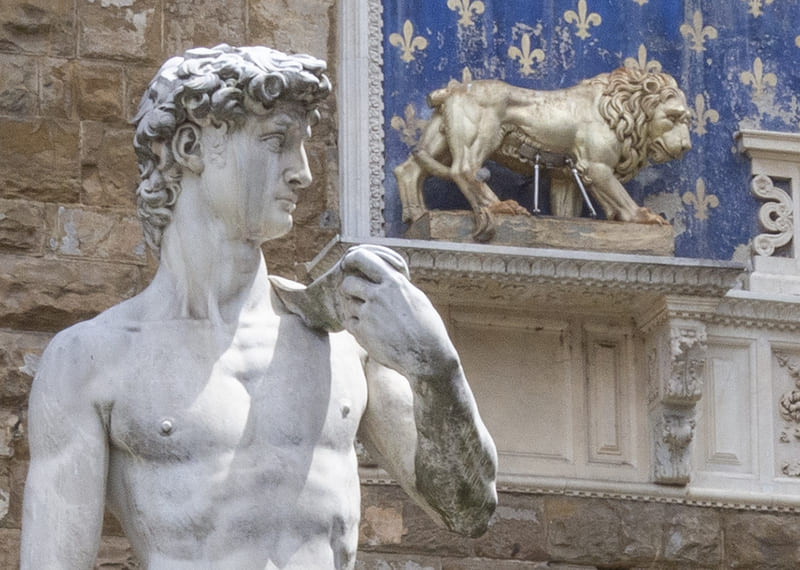
Are you a sculpture lover and you’re traveling to Florence? If so, you will definitely enjoy your time in the town where some of the major masterpieces of European sculpture are actually displayed for free in the urban space.
Let me take you on a walk through the most important sculptures in Florence.
In Florence, it is enough to go for a walk between the Cathedral and Piazza della Signoria to discover some of the major masterpieces of Italian sculpture. In some cases, you will find the copies displayed in the public space, while the originals will be kept inside the museums for protection. Often, however, the originals are still out there, decorating the center of Florence today. Here are my favorite sculptures in Florence.
How many statues are there in Florence?
It’s impossible to say how many sculptures decorate the centre of Florence. It’s enough to visit the Piazza Duomo and to look at the facade of the Florentine Cathedral, to be overwhelmed by the richness of the sculptural decoration.
Then we have the Bell tower and the Baptistery that also display rich sculptural decoration on the outside.
In Florence you will also find Orsanmichele, adorned with sculptures on its four facades and Piazza della Signoria, with the Loggia del Lanzi, that preserves Roman and Renaissance original statues.
We can safely say that more than hundred statues are displayed in the historical centre of Florence.
Then we have the Florentine museums that preserve even bigger numbers of sculptures: the Bargello, the Archaeological Museum, the Uffizi Gallery: their collections include thousands of unique and precious sculptures that spread from the Etruscan era to the modern times.
Florence statues: where can you find them?
The most important spots for the sculpture lovers in Florence are:
- Piazza Duomo
- Piazza della Signoria
- Orsanmichele
If you want to see the most precious sculptures preserved in the Florentine museums, you can’t miss:
- Bargello
- Museo dell’Opera del Duomo (Cathedral Museum)
- Orsanmichele
- Archaeological Museum of Florence
- Museo Marino Marini
Florence statues
Florentine artists had an enormous impact on the development of European arts and sculpture played a prominent role in the introduction of the Renaissance style. The revolution of the Renaissance started through architecture but it was in sculpture that Donatello and Ghiberti were experimenting with perspective, representation of depth and tried to achieve emotional engagement of the viewers.
This is why through looking at the sculptures in Florence, you can learn about the birth of the Renaissance.
Which are the most important sculptures not to miss? Here is a little guide to the most important sculptures in town.
Sculptures in Florence: The Gates of Paradise
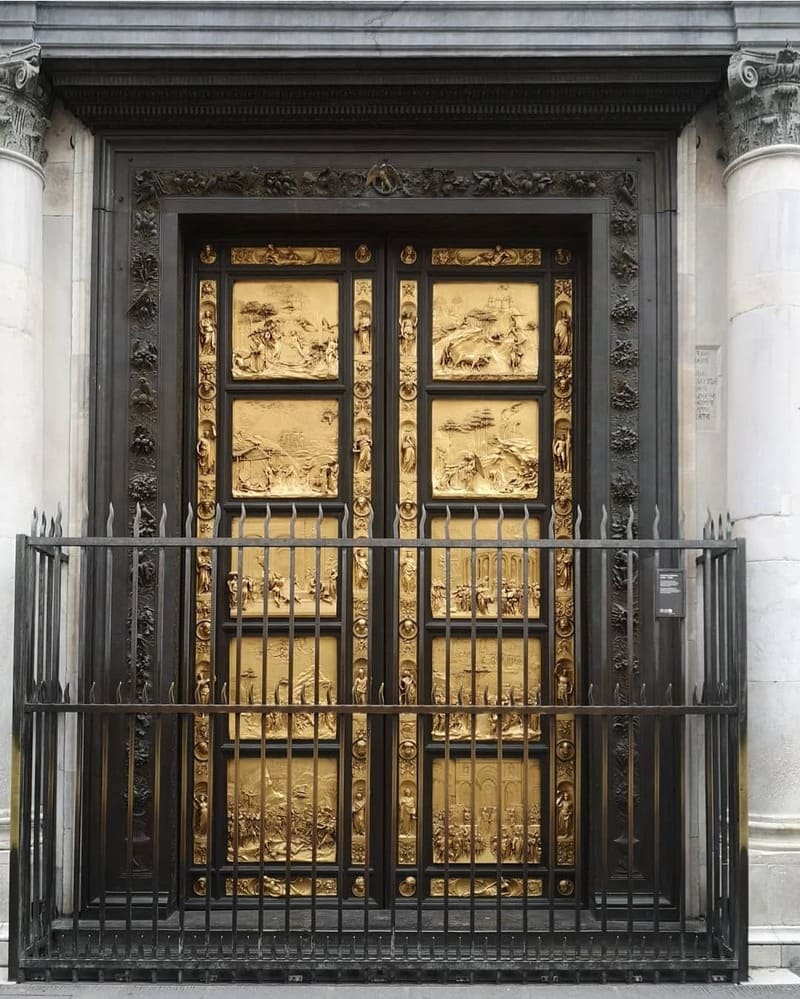
The Gates of Paradise are a set of bronze doors designed by Lorenzo Ghiberti between 1425 and 1452 for the Florentine Baptistery. Lorenzo Ghiberti was one of the most innovative artists active in Florence during the first decades of the 15th century.
Today, the original door is kept inside of the Cathedral Museum, but on the Baptistery facing the Florentine Cathedral, you can still see the copy.
The gates feature ten big bas-reliefs that narrate the stories of the Old Testament. Ghiberti, in his doors, used the so-called “continuative narrative,” which is a method to tell stories that incorporates the same protagonists within one composition many times as the story evolves. For example, in the upper left corner, you will see the Stories of Genesis: the Creation of Adam will be in the lower left corner of the composition, the Creation of Eve at the center, the Original Sin in the backdrop on the left side, and the Expulsion of Adam and Eve from the Paradise on the very right side of the scene. So, four different events are actually located in one frame.
Ghiberti could have applied this narrative technique to his door, also because he designed the scenes using linear perspective, the geometrical method of projecting depth on a surface. It allowed Ghiberti to create the stage sets for his compositions. His protagonists move within the space designed for them by the sculptor.
Another innovative aspect of Ghiberti’s door is the use of the different depth of relief in his compositions. If you look at the door carefully, you will notice that some figures are completely detached from the background, fully three-dimensional, while some other elements are simply sketched on the background in a very flat way. Again, that helped the artist in the creation of the stage sets within which he located the protagonists of his stories. The changing depth of the relief reproduces the depth and the idea of infinity, showing some figures as closer to us and other elements being located far in distance.
Statue in Florence: Saint George by Donatello
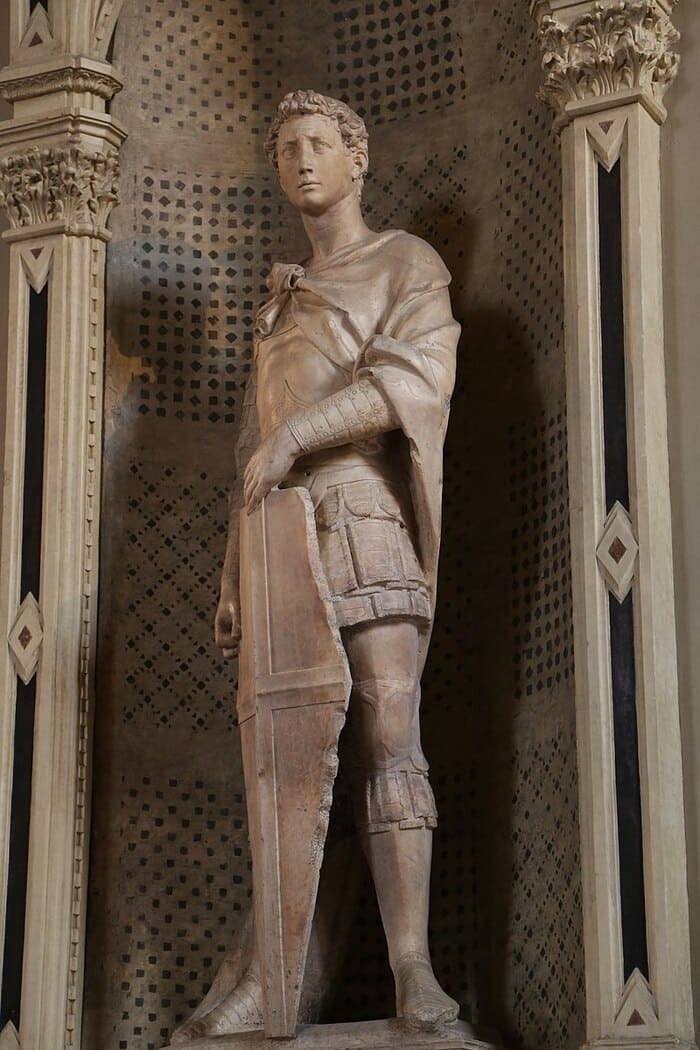
Along the main street of Florence, Via Calzaiuoli, stands the monumental building of Orsanmichele. Today it is a church with an important painting dedicated to the Virgin Mary on the ground floor. However, it developed from a medieval grain market in the second half of the 14th century. When the market was transformed into the church, the local guilds were asked to sponsor the construction of niches decorated by figures of the patron saints of every single guild.
Orsanmichele is a textbook on European sculpture. The different statues show the evolution of the style from medieval toward the Renaissance. Here, you can find a niche with the famous statue of Saint George designed by Donatello. Today, on the outside of Orsanmichele, you will find a copy of this statue, while the original is kept at the Bargello Museum in Florence.
The statue of Saint George features the early style of Donatello, who is still looking toward the Gothic with the verticality of his composition, whilst already being partly inspired by classical art. Saint George almost seems like a Roman orator, with wide arms proudly standing in his niche.
Below, however, in the predella of the tabernacle, there is a bas-relief representing the scene with Saint George saving the princess. On the very right side of the composition, Donatello, for the first time, experiences and examines the possibilities of linear perspective. The portico behind the princess starts diminishing as it gets deeper in space. This is one of the first examples of the correct projection of space on a surface in European sculpture.
Statue in Florence: Doubting Thomas by Verrocchio
During the 1470s, the Tribunale di Mercatanzia, the court solving controversies between merchants, commissioned Andrea del Verrocchio for the niche for Orsanmichele with a statue representing the Doubting Thomas.
Saint Thomas was one of the Apostles and according to the Gospel he did not fully believe in the resurrection of Christ. Being absent during the first apparitions of resurrected Jesus, he questioned the veracity of the accounts on these miraculous events. When he finally had a chance to face Christ himself, Jesus invited him to put his fingers into Christ’s wounds and to check if he really resurrected.
Verrocchio’s composition of Doubting Thomas is a unique example of 15th-century Florentine bronze casting. The statue surprises us with dynamic folds of the dresses, the gestures, and the faces of Thomas and Jesus.
When Verrocchio was working on this composition, young Leonardo da Vinci was actually working as a pupil in his workshop. Many features, especially regarding the faces of the protagonists of Verrocchio’s statues, are quite similar to Leonardo’s compositions.
Today on the façade of Orsanmichele, you can find a copy of this statue, while the original is kept in the Museum of Orsanmichele on the upper floor of the building.
Statue in Florence: Judith and Holofernes by Donatello
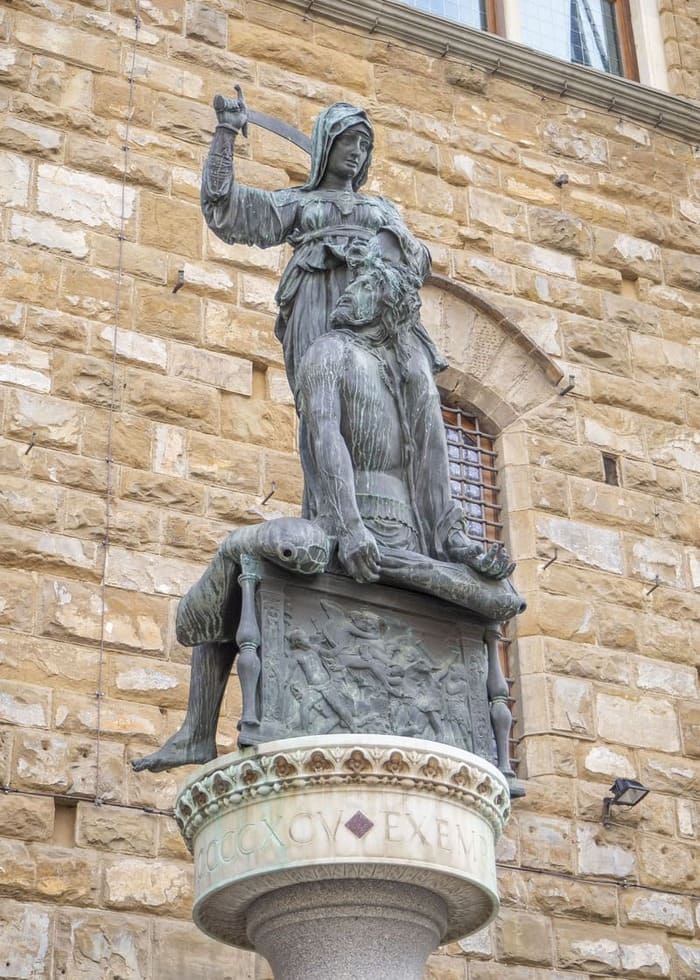
Piazza della Signoria is the Florentine square with the largest number of important sculptural masterpieces still displayed here today. One of the first statues that reached the square was Judith and Holofernes by Donatello. It was designed by the artist in the mid-15th century as a fountain for the Palazzo Medici.
The statue was stolen by the people of Florence in 1494, when they sent the Medici family into exile. They took the statue, which used to decorate the garden of the Palazzo Medici, and placed Judith in front of the Town Hall as a symbol of strength, resilience and independence of the Republic of Florence.
The statue represents a heroine from the Old Testament, Judith, who saved her people, the inhabitants of Bethulia, by killing the military leader of the Assyrians, who were attacking them. Judith managed to gain the trust of Holofernes, but used it to sneak into his tent and then decapitated him without hesitation. The story of a weak woman who won against the powerful Holofernes, became for the people of Florence the symbol of the weak Republic of Florence, who managed to win against the powerful Medici and kept fighting its enemies..
Judith stood there until it was moved to make space for a slightly more famous companion, Michelangelo’s David. Today, the original statue is kept inside the Palazzo Vecchio, while a copy stands in the square.
Statue in Florence: David by Michelangelo
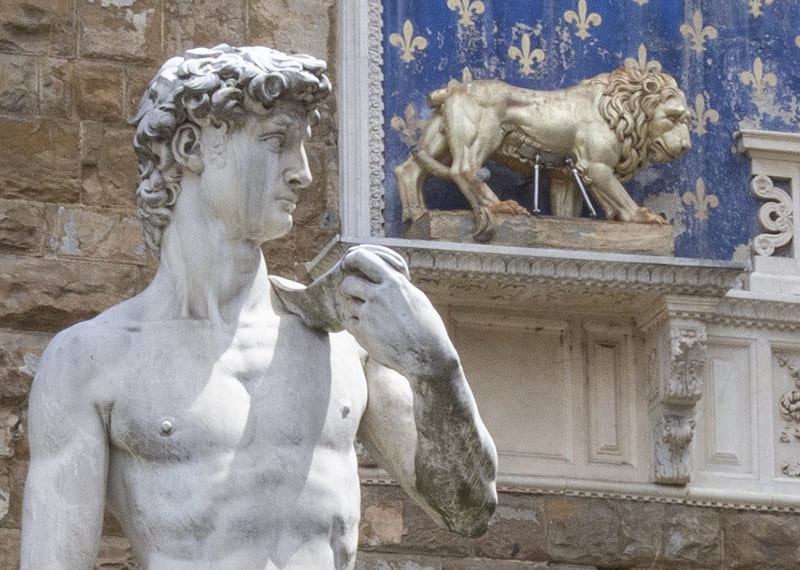
In front of the Town Hall, you can also see a replica of the famous David by Michelangelo. This statue was commissioned in 1501 by the cathedral authorities. Initially, David was meant to be placed on one of the apses of the Florentine Cathedral, but it was never put on the roof of the church.
When the artist finished David in 1504, the people of Florence immediately perceived the uniqueness of the sculpture. They were fascinated by the detailed representation of the human body on this male nude and read in it the allegory of David’s strength, virtue and excellence. David became for them yet another republican hero, who managed to overcome an impossible enemy, Goliath. For the people of Florence David’s victory celebrated their victory against the Medici family and so they decided to place it in front of the Town Hall as yet another republican symbol in this most meaningful square of civic power.
The story of young, weak David defeating Goliath became an allegory of the weak state, the Republic of Florence, overcoming the powerful Medici. And so, David became another republican hero in Piazza della Signoria.
The statue stood there until 1873, when the government of Florence decided to move it inside the Accademia Gallery for protection. The replica was made in 1910. Even on the replica, you can see the particularities of David’s body. It testifies to Michelangelo’s interest in anatomy and his anatomical studies that he undertook before sculpting this unique work.
David’s nudity is one of the most innovative and meaningful elements of the statue. By representing this biblical hero as a naked, perfect, mature man, Michelangelo returned to the ideals of classical art. Nudity in classical antiquity symbolised virtue, strength and physical perfection. In Michelangelo’s vision David became a classical hero. The people of Florence understood this allegory and attributed David’s virtues to themselves. They wanted to be seen as just, strong, virtuous and victorious as David. Until today the people of Florence feel a strong connection to this unique artwork.
Statue in Florence: Perseus by Benvenuto Cellini
In 1530 the Medici family conquered Florence and the Republic signed the capitulation after months of devastating siege. Alexander de’ Medici received the title of the Duke of Florence in 1532, but ruled only five years. After his assasination, young Cosimo de’ Medici stepped in with the title of Cosimo I in 1537. The aim of the young Duke was the reinforcement of the family position and construction of a prestigious European court in Florence. Therefore, Cosimo decided to transform the ancient town hall, the Palazzo dei Priori, the heart of the Republic of Florence, into the first Ducal Palace for him and his wife.
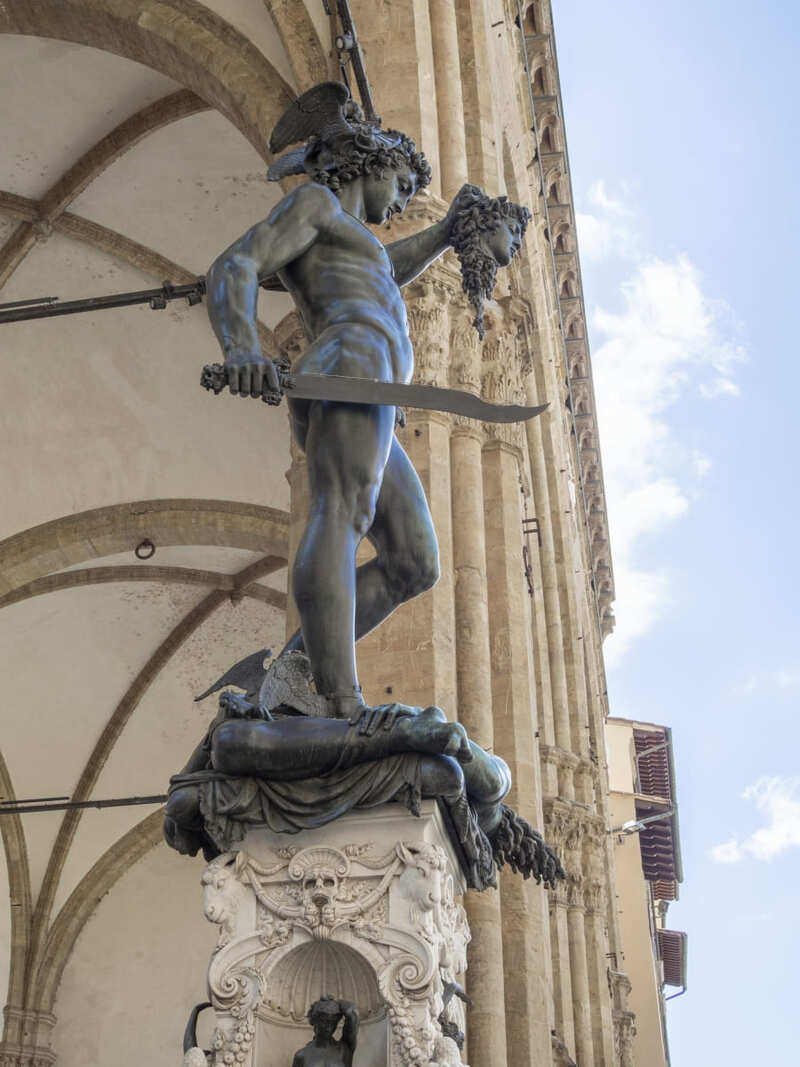
The presence of the “republican” David at the door of the Palazzo constituted a challenge for Cosimo. Michelangelo’s fame and the importance of David for the people of Florence did not allow Cosimo the removal of the famous masterpiece. This is why the Duke decided to answer to David’s republican claims with another statue, which would represent his powerful rule. In 1545 the Duke commissioned Benvenuto Cellini for a statue of Perseus beheading Medusa. This magnificent bronze cast was placed under the Loggia dei Lanzi in 1554 and became a clear statement about Cosimo’s authority.
Still today you can admire the original Perseus under the Loggia. The statue represents the hero after he beheaded the monster Medusa, holding Medusa’s head in his hand.
If for the Duke Cosimo Perseus represented a symbolic answer to David, for the artist it was an opportunity to challenge Michelangelo himself. Cellini wanted to create an ultimate masterpiece and thus he decided to cast the entire figure of Perseus using just one mold. He managed to achieve this after various attempts and therefore, to underline his success, he decorated the back of Perseus’s head with his own self-portrait. If you look carefully on the back of Perseus’s head, you can actually spot a face there. Perseus’ helmet creates Cellini’s eyes and nose, while his hair became the artist’s beard.
Perseus is just one of the many masterpieces displayed today under the Loggia. In fact, the Medici family did not use this space for public assemblies, as it was used during the Republican period. The Medici transformed it into yet another representative space where to display the opulence of their artistic collections.
Statue in Florence: The Rape of the Sabine Women
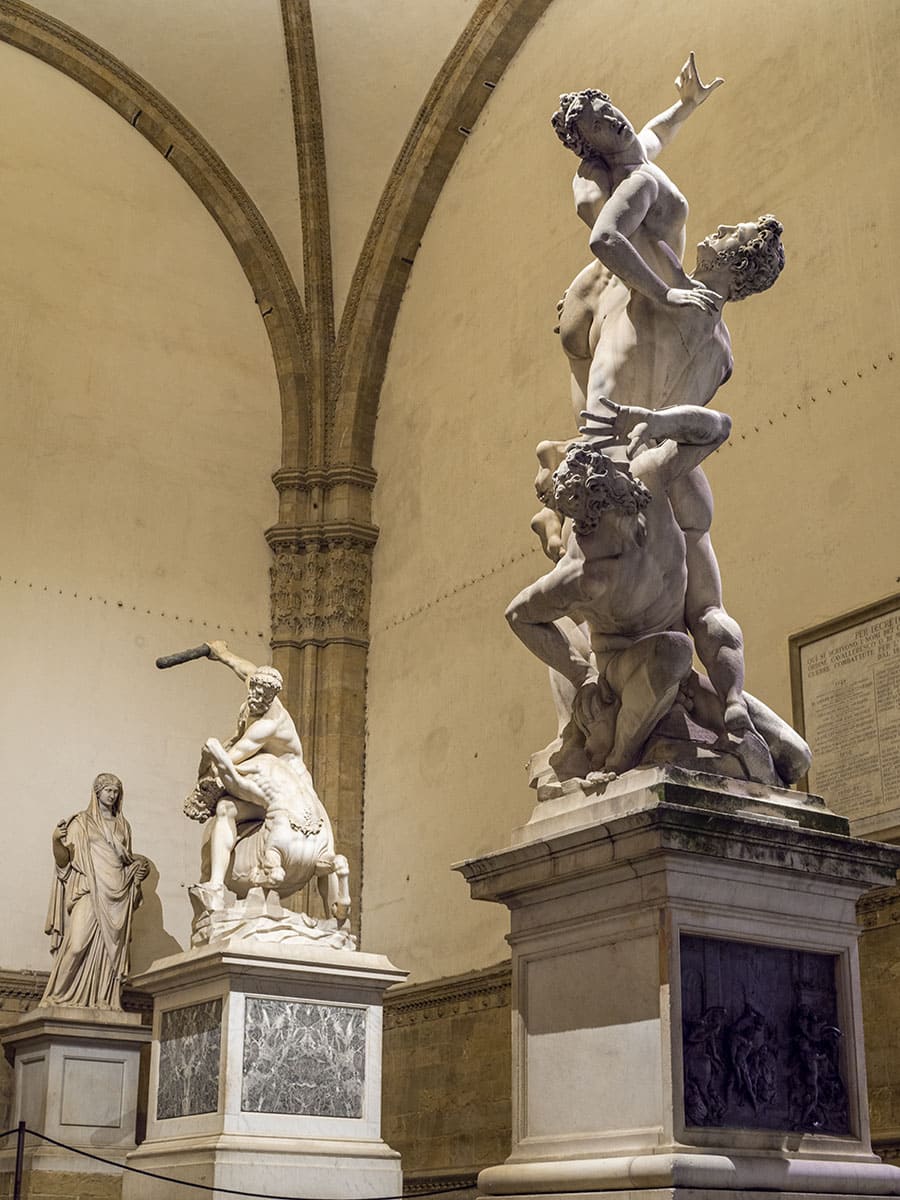
In 1583 another breathtaking masterpiece was placed under the Loggia dei Lanzi: Jean de Boulogne’s Rape of the Sabine Women captured the attention of the Florentine public as soon as it was revealed by the artist. Still today the original of this masterpiece is placed under the right arch of the Loggia.
Jean de Boulogne, known to everyone as Giambologa, was a Flemish master hired at Cosimo’s court. In his art he tried to emulate Michelangelo’s genius and he often emphasised the dynamic compositions, torsion and movement.
In his Rape of the Sabine Women he reached the highest point of his excellence and artistic skill: the three human bodies, sculpted from one block of marble, are represented in an impossible torsion, as a spiral or snake, twisting one around another.
When Giambologna was working on this piece, he did not have in mind any particular story. He just wanted to achieve the impossible and to create a composition that could be observed from 360 different points of view. When the work was revealed to the public, the Florentine erudites saw in it the representation of an event from the early history of Rome.
According to Roman historians Romulus and his followers had difficulties in marrying, as no father wanted to agree on the marriage of the daughter with these not very sophisticated men. Therefore, in order to get wives, the Romans attacked and raped the Sabine women, during a religious festival.
Giambologna’s composition was interpreted as featuring a Sabine woman being raped by a Roman while a Sabine man tries to protect her.
The whole composition is based on this corkscrew-like torsion which marks the highest point of the mannerist aesthetics of excess and sophistication.
The less famous statues in Florence that worth the visit
The sculptures listed above are not the only masterpiece that you can admire in the urban space of Florence completely for free.
Other less famous, but not less impressive sculptures adorn Piazza della Signoria and other Florentine squares. Which are they?
Hercules and Cacus by Baccio Bandinelli
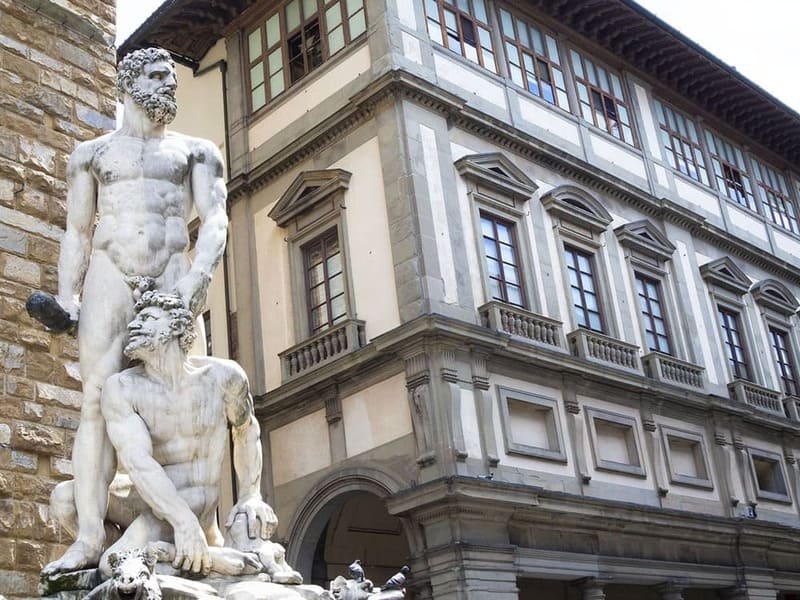
Next to Michelangelo’s David, on the right side of the entrance to Palazzo Vecchio stands the impressive Hercules and Cacus by Baccio Bandinelli. Designed between 1530 and 1534 and commissioned by the Medici pope Clement VII and by the first Duke of Florence, Alexander de’ Medici, this statue was supposed to smoothen the republican meaning of David. In fact, the strength of Hercules represented in this marvelous sculpture was suggesting that David symbolises intellect, and not the republican victory against the Medici family.
The sculpture represents the strongest of the classical heroes, ready to kill Cacus, a thief, who dared to steal his sheep.
Bandinelli, inspired by the muscular male bodies represented in Michelangelo’s art, pictured Hercules as a mighty man sculpting countless muscles on his powerful body. This exaggeration, which goes against a faithful representation of the human body, was part of the stylistics of mannerism, the late phase of the Renaissance.
Fountain of Neptune in Piazza della Signoria
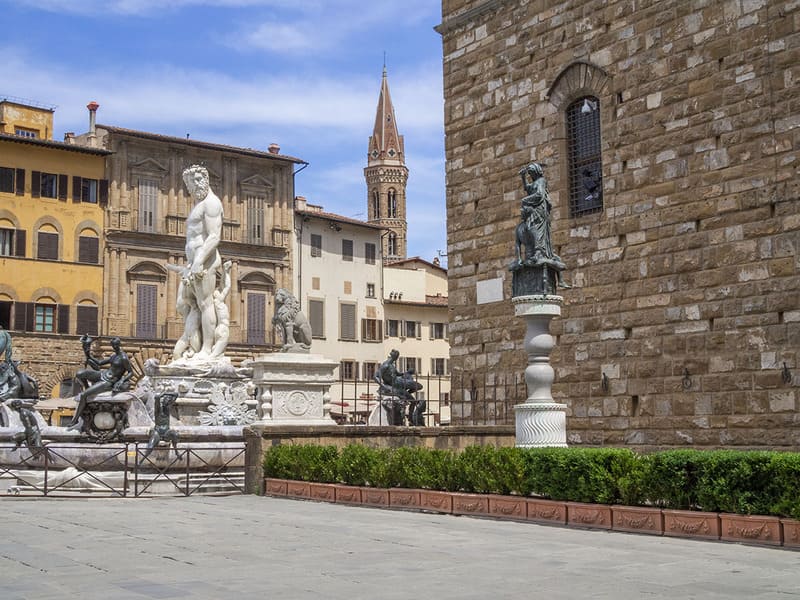
Cosimo I, who raised to power in 1537, promoted a series of artistic projects that were supposed to glorify his rule. Imitating the emperors and popes, who sponsored the construction of various fountains spread across the Eternal City, he decided to share the life giving water with the citizens through a construction of a magnificent fountain in Piazza della Signoria, in front of his Ducal Residence.
The fountain of Neptune was designed by Bartolomeo Ammantati between 1550 and 1575 and became one of the most powerful symbols of Cosimo’s power. It features the god of the oceans surrounded by sea monsters and sea horses. The numerous fountains sprinkle the water around Neptune creating the effect of marvel and magnificence.
Horse monument to Cosimo I in Piazza della Signoria
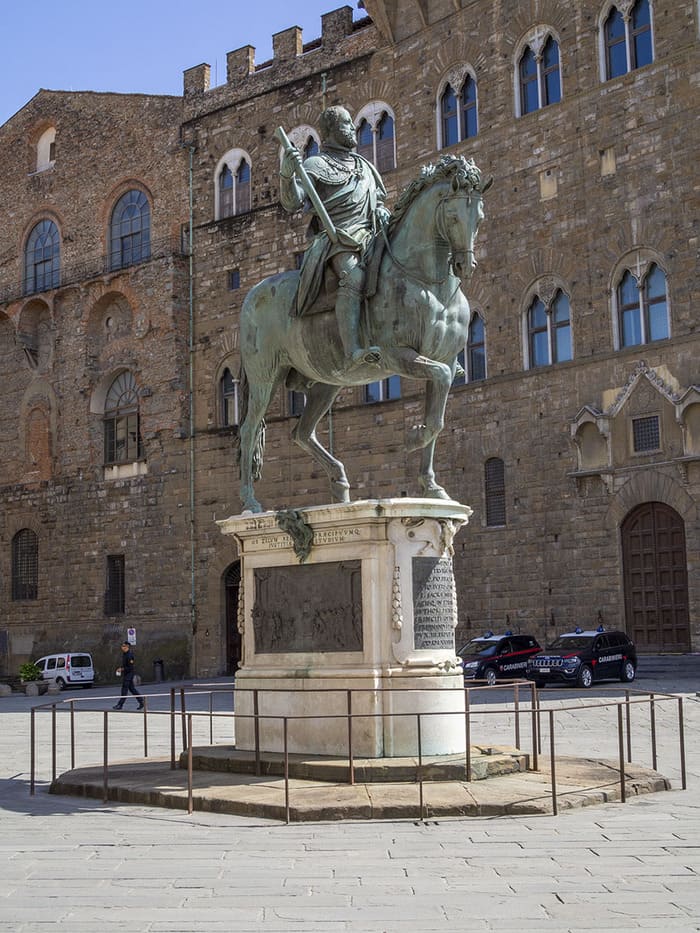
In 1587 Ferdinand I commissioned the Flemish artist Jean de Boulogne, known as Giambologna, for a horse monument celebrating the figure of his father, the Duke Cosimo I. The execution of this impressive work required exceptional technical skills and resources. In fact, as the horse is cast with the use of one single mold, the Duke provided the artist with a big studio space, where this massive cast was made.
The statue represents Cosimo who sits with pride on his horse and looks at his subdues. The reliefs positioned around the marble basement represent the most significant moments from Cosimo’s rule, such as the Victory against Siena and the Awarding of the Title of Grand Duke of Tuscany.
Horse monument to Ferdinando de’ Medici in Piazza Santissima Annunziata
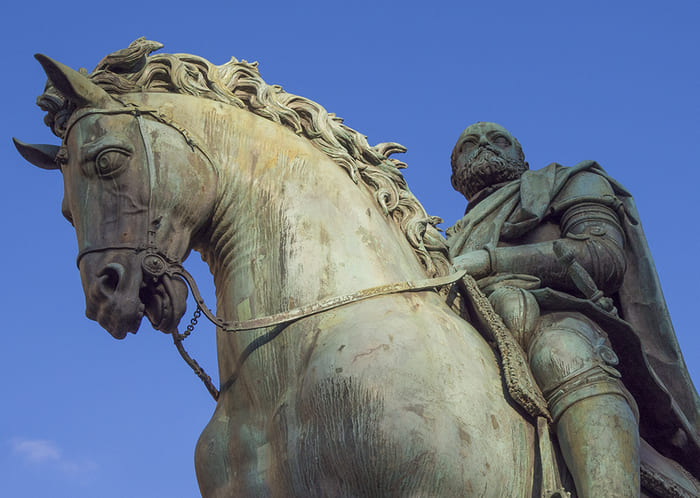
After the execution of the horse monument to his father, in 1602 Ferdinand I commissioned Giambologna, who worked together with his pupil Pietro Tacca, for the horse monument in his own honour. The Horse Monument for Ferdinand I was placed in Piazza Santissima Annunziata, at the North edge of the historical centre of Florence.
The statue became famous because of the symbolic representation of the ducal power and authority, through the image of the bee queen, surrounded by the working bees.
It is said that the misbehaving kids in Florence are asked to count the bees as a form of a joyful punishment.
Fountains with Sea Monsters in Santissima Annunziata
On the sides of the Horse Monument of Ferdinand I you can see today the two fountains with the sea monsters, masterpieces of Baroque sculpture. They were commissioned to Pietro Tacca in 1626 and placed in the square in 1641. They adorn one of the most important Florentine squares and create a link between all the monuments in Annunziata: the Basilica, Brunelleschi’s Ospedale degli Innocenti and the horse monument at the centre.
The perfect itinerary to discover all the statues in Florence
Do you want to discover Florentine sculptures during a city walk? Use this map, that signs the most important squares where you can find Florence statues:
Florence sculpture: can be visited for free?
The urban space of Florence is an open space museum and many of the original Renaissance masterpieces are still displayed in the squares of Florence. You can admire them for free.
Piazza della Signoria is the square where you will find most of those original masterpieces:
- Perseus by Benvenuto Cellini
- Hercules and Cacus by Baccio Bandinelli
- Rape of the Sabine Women by Giambologna
- Hercules and Centaur by Giambologna
- Roman statues under the Loggia dei Lanzi
- The Fountain of Neptune by Bartolomeo Ammannati
- Horse monument of Cosimo I by Giambologna
In many cases, the original statues are kept in the museums, while their copies are displayed in the urban space of Florence. If you want to see the original of Ghiberti’s Gates of Paradise, you have to visit the Cathedral Museum.
The original statues from Orsanmichele are kept inside the Orsanmichele museum, while Donatello’s Saint George is at the Bargello.
How long does it take to visit the most famous statues in Florence?
A city walk discovering the most important sculptures displayed in the urban space of Florence will take you two to three hours.
You have to focus on Piazza Duomo, Orsanmichele and Piazza della Signoria.
If you have more time you can arrive at Piazza Santissima Annunziata, to admire the horse monument to Ferdinand I de’ Medici and Piero Tacca’s fountains with sea monsters.
Florence statues: when to visit them?
The statues are displayed in the urban space of Florence all year long. As I often say, the low season, from November to March, is the best time for a cultural holiday in Florence. The streets and the squares of Florence are less crowded during these winter months, and you are free to enjoy the art without the rush.
In any case, you can plan this itinerary for any time of the year. The statues of Florence will always surprise and astonish you!
Do you want to learn more about the history of Renaissance sculpture?
Contact us, so we can organise for you a custom itinerary on Florentine statues!