

As you walk through the medieval heart of Florence, it is impossible not to notice the presence of numerous symbols carved or painted on Florentine palaces, churches, and monuments. Coats of arms, shields, and animals populate the city. These are not mere decorative elements. These images represent the symbols of Florence—true keys to understanding its history, its identity, and its civic spirit.
But what do these symbols of Florence mean? Let us discover together their origins, their meanings, and the fascinating stories they preserve.
Florence symbols: the Lily
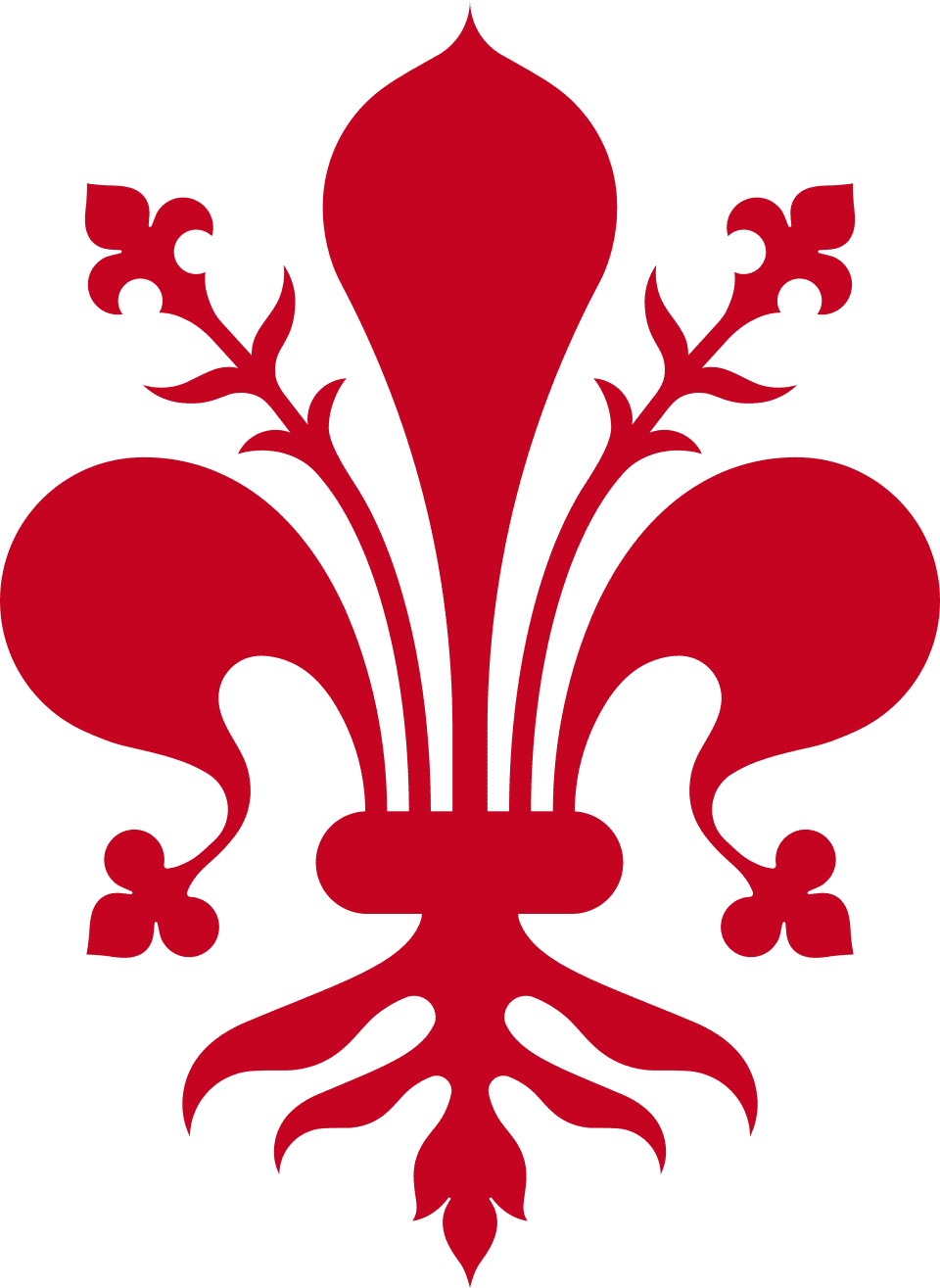
One of the most recognizable symbols of Florence is the red flower on a white background, commonly known as the Florentine lily or giglio. Interestingly, this is a misnomer: the flower depicted is actually an iris, not a lily.

Why is the lily the symbol of Florence?
There is no certain answer on the question why the lily is the symbol of Florence. One of the most widely accepted theories links this symbol to the city’s Roman origins. Florence, founded in 59 BC under the name Florentia, is thought to have taken its name from the goddess Flora, the Roman deity of spring and flowers. The city was founded precisely during the period of festivals held in her honor, between April 28 and May 3.
The connection with Flora may have inspired the name Florentia and the adoption of a flower as its symbol.
During springtime irises are commonly found in Tuscany, especially in the Arno River Valley, making them a natural and familiar choice for the city’s imagery.
The Lily, symbol of Florence: culture and tradition
The design of Florence’s coat of arms has evolved over time. Under the Ghibelline rule, the city’s shield displayed a white iris on a red background.
However, in 1251, with the rise of the Guelphs, the colours were reversed to mark the political shift: a red lily on a white background — the version we still recognize today.
This change introduced a curious paradox: red irises do not exist in nature. For this reason, in the 20th century the Florence Iris Association established an annual competition to obtain a true red iris. So far, specimens in shades of orange, purple, and dark red have been developed, but a genuine red iris has yet to be achieved.
The Florentine Lily for Dante Alighieri
Even Dante, perhaps the most famous Florentine of all time, refers to this symbol and to the curious change in the colours of the city’s coat of arms. In fact, in Canto XVI of Paradiso, Cacciaguida—Dante’s ancestor—says:
“With these people and with others with them
I saw Florence enjoy such peace
That there was nothing for which she had to weep;
With these people I saw her inhabitants
In glory and justice, so that the lily
Was never turned upside-down on the flag-pole
Nor, through divisions, stained red with blood.”
Cacciaguida states that he had known a peaceful Florence, so much so that he had never seen the city defeated in war (the lily was never dragged upside-down in a sign of defeat). At that time, the lily had not yet become red as a result of internal struggles. The theme of conflict within Florentine society recurs throughout the Divine Comedy, because the divisions and struggles among different factions were at the root of Dante’s exile from Florence in 1302.
In the tercets of Paradiso, Dante recalled the change in the colours of the lily, reaffirming his criticism of the political situation of his native city.
Florentine lily: where can be found around Florence?
The Florentine lily is undoubtedly an image you will encounter everywhere throughout Florence, often used for commercial purposes. It appears on T-shirts, mugs, keychains, bags, hats, restaurant signs, as well as flags and shop windows.
The historic lily, painted as a symbol of the civic community, can be found above all in three buildings that were central to public life in medieval Florence.
On the façade of Palazzo Vecchio, you can see the lily just below the palace balcony, placed alongside other coats of arms.
The lily also decorates Giotto’s Bell Tower, a building that represents the pride and power of Florence. The bell tower was designed by the famous painter Giotto, who directed the construction of the Cathedral starting in 1334. Giotto died in 1337, and the construction of the bell tower was completed by Francesco Talenti.
The Florentine lily is part of the monument’s sculptural decoration and appears alongside the cycle of allegories of the professions created by Andrea Pisano, sculpted between the 1330s and the 1340s.
Other Florence symbols
Each symbol of Florence tells something about Florentine identity, its origins, and its civic pride. Let us now look at the main symbols of Florence and their meanings.
The Florentine Lion Marzocco: a symbol of strength and pride
Among the most powerful symbols of Florence is the lion, known as the Marzocco. In medieval symbolism, the lion represented protection, power, and courage, qualities that Florentines have always attributed to themselves.
Moreover, until the end of the 18th century, Florence housed real lions, kept in cages near Via dei Leoni, behind the Palazzo dei Priori. Each year, a “symbolic hunt” took place in Piazza della Signoria, where animals such as deer and rabbits were placed together with the hungry lions. The Florentines gathered in the square and observed with satisfaction how the lions killed their prey. This practice symbolized Florence’s strength in dominating its enemies.
The tradition continued until 1777, and the birth of each new lion was an event celebrated throughout the city.
Donatello’s Marzocco
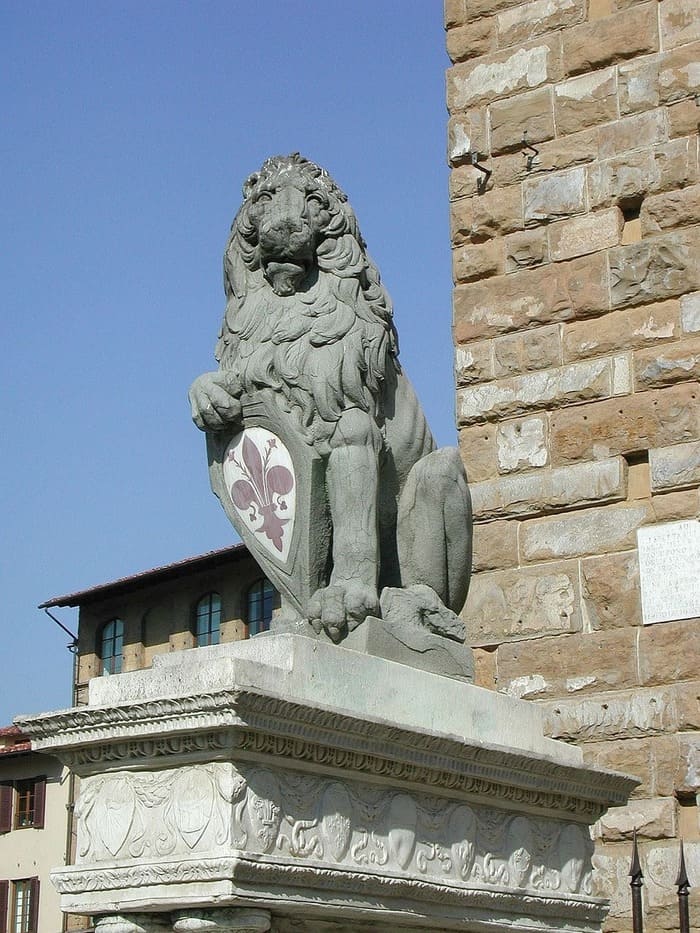
The most famous artwork depicting the Florentine lion is the Marzocco sculpted by Donatello between 1419 and 1420. The lion rests its paw on a shield bearing the Florentine lily, representing the union of strength and civic identity. Donatello portrayed the animal’s anatomy with precision and detail, likely after studying the real animals kept in cages behind the Palazzo dei Priori.
Today, in Piazza della Signoria, where the sculpture was displayed in the 15th century, a copy of the work is on view. The original is preserved in the Bargello Museum, together with Donatello’s David and Verrocchio’s David, other important civic symbols.
The Cross of the People: a symbol of freedom
Another of Florence’s most important symbols is the Cross of the People, a red cross on a white background. This image symbolized the civic participation of the Florentine people in the government of the Republic. It expressed the Florentines’ desire to protect themselves against aristocratic power.
Originally, it was adopted by the Captain of the People, and later by the Gonfaloniere of Justice, the official responsible for ensuring the city’s democratic balance.

The Eagle of the Arte dei Mercanti Calimala
In the Middle Ages, the powerful Florentine guilds that governed the city, each had their own symbol. Among them, the Arte di Calimala, the wealthiest and most influential, which brought together Florentine merchants, was represented by the image of an eagle carrying bales of wool.
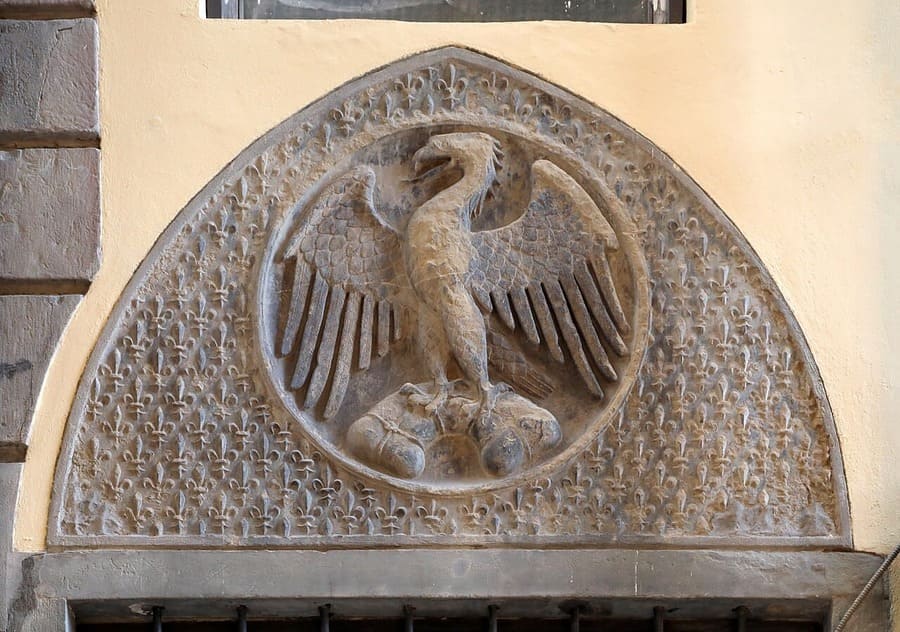
The Calimala financed various religious institutions and supported numerous artistic projects. For this reason, you can find the image of the eagle on both the Baptistery and the Church of San Miniato al Monte, which benefited from the patronage of the merchants.
This image also decorates the tabernacle containing the statue of Saint John the Baptist, the patron of the Calimala, placed on the façade of Orsanmichele. The presence of the guild’s emblem reminds us once again of the wealthy patron behind the work.
The Lamb of the Arte della Lana
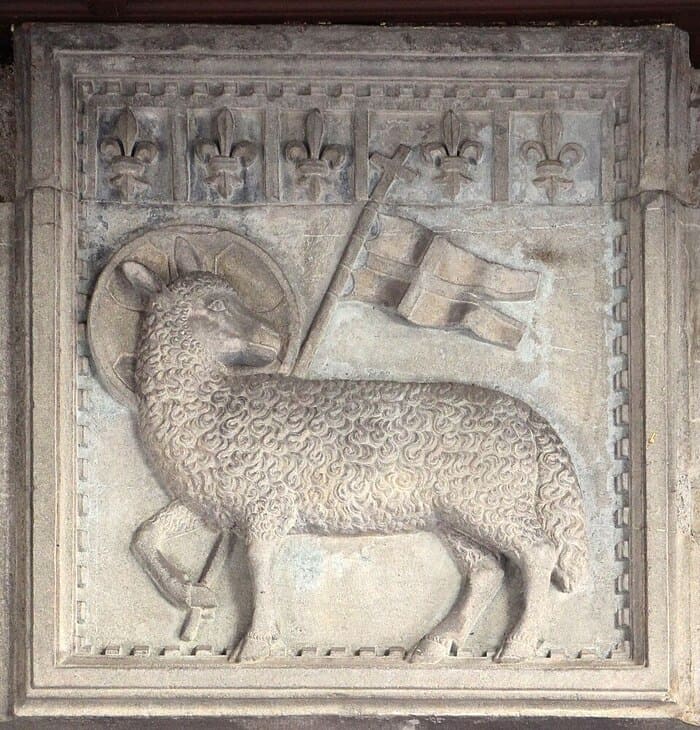
The second of the most powerful Florentine guilds was the Arte della Lana. Their symbol depicts a lamb holding a banner.
The Arte della Lana was the most important co-financier of the construction of the new cathedral dedicated to Santa Maria del Fiore. For this reason, the symbol of the wool producers appears repeatedly on the façades of the Florence Cathedral.
As you walk through the city, you will see it in many places. It also decorates the ancient headquarters of the guild, located behind the Church of Orsanmichele, which today houses the Dante Society. It can also be seen on the building next to the famous Fontana del Porcellino, the former site of the Stock Exchange.
Florence symbols: where to admire them?
If you are in Florence and want to see these symbols up close, here are some places where you can find them:
- Giotto’s Bell Tower
- Baptistery of San Giovanni
- Palazzo Vecchio
In particular, under the cornice of Palazzo Vecchio, you can notice numerous coats of arms painted during the 19th-century restorations, faithful to medieval heraldic tradition.
Artistic, religious, urban, literary, and traditional Florence symbols
Florence is a profoundly symbolic city, where art, religion, civic life, and tradition intertwine in a unique visual and cultural language.
- Among the most important civic symbols is the Florentine Lily.
- The artistic symbol of Florence is Michelangelo’s David, an emblem of freedom and human ingenuity.
- Religious symbols are the Cathedral of Santa Maria del Fiore, with Brunelleschi’s dome, together with the Basilica of Santa Croce, a place of memory for great Florentines.
- On the literary level, Florence is inseparably linked to Dante Alighieri, the father of the Italian language and a symbol of Florentine literary tradition.
- The symbols of power are the Florin gold coin, a testament to medieval economy, and the Medici coat of arms, representing the authority of the family that ruled the city for more than two centuries.
Do you want to discover Florence through its symbols?
Each symbol of Florence tells a story of pride, identity, tradition, and struggle. If you want to explore these emblems in depth, accompanied by a local expert who knows the secrets of the city, book a personalized guided tour.
Contact us to organize your tailor-made experience discovering the symbols that make Florence unique!