

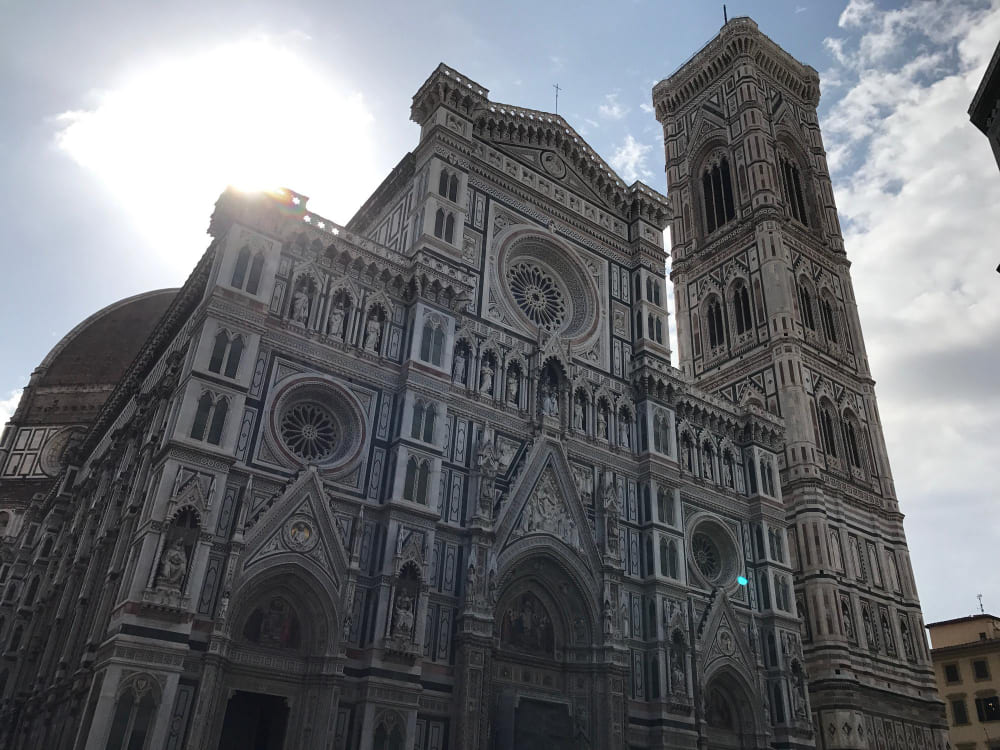
The Florence cathedral is Santa Maria del Fiore, Florence’s main religious monument and one of the most iconic examples of Gothic architecture in the world.
The construction began in 1296, and for many visitors, the Duomo is a must-see attraction in Florence. But with the long queues that often form between April and October, one might wonder if it’s truly worth the wait.
In reality, there are many ways to explore the Florence cathedral and its surrounding complex.
Let’s take a detailed journey through the history, the architecture of Florence, and the artistic treasures of this remarkable monument.
Cathedral of Santa Maria del Fiore: history and architecture
The Cathedral of Santa Maria del Fiore was built on the site of an ancient church, Santa Reparata, which had stood in the same location since the 5th century.
In the 13th century, Florence was experiencing a period of great demographic and economic growth, and the old church no longer reflected the city’s power and wealth.
Thus, in 1296, the Florentine government entrusted the project to Arnolfo di Cambio. As often happened in the Middle Ages, construction continued even after the death of its first architect. After Arnolfo, the renowned painter Giotto became master builder and designed the elegant bell tower that still stands beside the Duomo today.
Later, Francesco Talenti expanded Arnolfo’s original design, however creating new challenges for the construction of the dome.
Florence cathedral: the problems with the construction
By the end of the 14th century, the cathedral was almost completed, except for the dome.
The central opening, with a diameter of 45.5 meters (149.3 feet) and a drum 52 meters (170.6 feet) high, was too wide for traditional techniques, which required the use of enormous wooden scaffolding, called centering. A dome built entirely of bricks at that scale would have collapsed under its own weight.
The breakthrough came with Filippo Brunelleschi, who devised a revolutionary solution: a double-shell dome, with an inner and an outer shell connected to support each other, built without centering. To reinforce the structure, he used the Roman technique known as opus spicatum, or herringbone brickwork, which distributed the weight evenly. In addition, Brunelleschi designed scaffolding anchored to the parts of the dome already completed.
By closely observing the dome, even today you can still see the holes used to secure the work platforms.
Finally, Brunelleschi also designed cranes and machinery to lift heavy materials during construction, revolutionizing the management of building sites.
The dome was completed in 1436, becoming a masterpiece of Renaissance engineering. This revolutionary feat of engineering became famous throughout the world and is one of the symbols of the Italian Renaissance.
In the same year, the Florence Cathedral was consecrated by the Pope, on a day of great celebration for the city.
Visiting the Florence Duomo complex
Inside the Duomo, the furnishings are relatively austere: many of the original works are now housed in the museum. As a result, the interior space appears as a vast, largely empty environment. It’s really not worth waiting in a long queue for the visit to the church only.
Therefore, to truly appreciate the Duomo, it’s worth purchasing a combined ticket that includes entry to the cathedral, the Baptistery, the Cathedral Museum, and the archaeological site beneath the church.
Florence cathedral inside
The most interesting part of the visit inside the Duomo, is the visit at the archeological site of Santa Reparata, including a valuable 5th-century floor mosaic bearing the names of Roman-Christian donors, a testament to the transition from Roman to medieval culture.This visit is included in the cumulative ticket to the Duomo Complex.
What are the other treasures preserved in the church?
The unique 15th-century clock inside the Florence cathedral
One of the most fascinating artworks inside the Cathedral is the clock painted by Paolo Uccello in 1443. It measures time according to the hora italica, a system in which the day began at sunset. The work is large in scale, covering more than 40 square meters (430.6 square feet). The fresco of the great clock reflects the geometric design typical of Brunelleschi’s art: it is organized as a large circle inscribed within a square.
In this way, we can observe one of the fundamental principles of Renaissance art: everything is structured according to geometric forms and proportions, based on harmony and mathematical relationships.
The clock face has 24 hours, and the hands move counterclockwise: a fascinating relic that is still functioning today.
The Last Judgment in the cathedral of Santa Maria del Fiore
What strikes the visitors the most in the vast space of the Duomo is the gigantic fresco depicting the Last Judgment that decorates the interior of Brunelleschi’s dome. It was begun in the 16th century by Giorgio Vasari for Cosimo I de’ Medici, Grand Duke of Tuscany, and was completed by Federico Zuccari, who chose a faster technique and painted the scene on dry plaster. This controversial decision sparked strong criticism at the time.
The fresco is monumental in scale and is therefore one of the largest painted works in the world.
There are hundreds of figures. The scene shows Christ at the center, with saints and the blessed in the upper section and damned souls below, among devils and flames.
Dante and the Divine Comedy by Domenico di Michelino
On the north wall is the painting by Domenico di Michelino, dating back to 1465 and commissioned for the bicentenary of the birth of Dante Alighieri.
The work depicts Dante with Florence behind him and the three realms of the Divine Comedy at his side: Hell, Purgatory, and Paradise. Dante is portrayed according to the traditional features of his physical appearance: an aquiline nose, a red robe, a red cap, and a laurel wreath, a symbol of poetic glory. To Dante’s right, Florence is clearly recognizable, with the Cathedral and its dome, as well as the tower of the Palazzo Vecchio.
We can notice a curious detail: Dante holds a copy of his Divine Comedy, and rays of golden light emerge from the book. This light symbolizes the divine inspiration of the work, which aims to show all of humanity the path toward spiritual salvation.
Equestrian Monuments to Niccolò da Tolentino and Giovanni Acuto
Also on the north wall are two painted 15th-century equestrian monuments dedicated to the condottieri John Hawkwood and Niccolò da Tolentino. The first, created by Paolo Uccello in 1436, celebrates the English condottiero John Hawkwood, who achieved important military victories for the Florentine Republic. The fresco is famous for its innovative use of linear perspective. In fact, the base of the large monument is depicted in a very strong foreshortened perspective, viewed from below upward, corresponding to the viewpoint of the observer standing inside the Duomo. The horse, however, is painted in profile, in order to avoid an awkward depiction of the animal’s belly.
Twenty years later, Andrea del Castagno executed another fresco representing the condottiero Niccolò da Tolentino, who also achieved a significant military victory for the Florentine Republic. Through these two monuments, we can understand how the Duomo became a place for the celebration of the city’s glories.
The two monuments mark the return, in Western art, of the classical concept of glorifying military leaders through equestrian monuments. This idea, present in antiquity, reemerged during the Renaissance, inspired by the study of Roman culture.
Funerary Monuments inside the Duomo
Inside the Duomo there are also other funerary monuments that celebrate the great figures of the Republic of Florence. Among these you can find:
- the monument to the Bishop of Florence Antonio d’Orso, completed by Tino di Camaino in 1322;
- the monument to Marsilio Ficino, created by Andrea Ferrucci in 1521;
- the monument to the organist Antonio Squarcialupi, made by Benedetto da Maiano at the end of the 15th century;
- the monument to Arnolfo di Cambio, created by Aristodemo Costoli during the 19th century;
- the monument to Filippo Brunelleschi, executed by Il Buggiano in the mid-15th century;
- the monument to Giotto, commissioned by Lorenzo the Magnificent in 1490 and carried out by Benedetto da Maiano.
The Rose Window and the Stained Glass Windows
One of the most beautiful decorations inside the Duomo are the stained glass windows and the large rose window decorating the counterfacade. The latter was created from a design by Lorenzo Ghiberti in 1405 and depicts the Assumption of Mary. The rose window therefore glorifies the Virgin Mary, to whom the Duomo is dedicated.
The drum of the dome is decorated with eight stained glass windows illustrating stories from the New Testament and the Life of the Virgin Mary. These decorations were executed between the 1430s and the 1440s by the leading artists of the period. Donatello designed the scene of the Coronation of the Virgin, Ghiberti those of the Presentation of Jesus at the Temple, the Agony in the Garden, and the Ascension of Christ. Finally, Paolo Uccello is the author of the designs for the scenes of the Annunciation, the Nativity, and the Resurrection of Christ.
Florence Duomo: details on timing and tickets
To better understand the history of the Duomo complex, it is truly worth purchasing one of the combined tickets, which allow entry to the Cathedral while skipping the longest line, the one for free admission to the church alone.
The so-called “Ghiberti Pass” is the combined ticket sufficient for an in-depth visit to the complex. The ticket includes access to:
- the Cathedral of Santa Maria del Fiore;
- the Baptistery of San Giovanni;
- the Opera del Duomo Museum;
- the archaeological area of Santa Reparata.
If you wish to add to these monuments the experience of climbing Giotto’s bell tower, you will need the “Giotto Pass.” With the more expensive “Brunelleschi Pass,” you can also climb to the top of Brunelleschi’s dome.
Important! During the high season, between April and October, tickets for climbing the dome often sell out up to a month before the desired date. Therefore, if you know you want to climb the dome, purchase your ticket well in advance.
When buying tickets, always use the official website of the Duomo complex. This is the only way to avoid resellers and inflated prices.
The opening hours of the Florence Cathedral and its associated monuments vary throughout the year, so it is best to check them in advance.
Discover the secrets of Florence’s most iconic landmark with an expert guide — book your Florence Duomo tour today and experience history, art, and breathtaking views like never before! Contact us! We will be happy to organize your private tour in Florence!